GREEN

GREEN, Greening Residential Environments Empowering Neighborhoods, will be planting at least fifty-two street trees in Los Angeles in less than three weeks, on January 18. Sadly, none of us will attend this year.

Only one of us attended the first tree planting project by GREEN twenty-two years ago. One may not seem like an impressive number, but it was half of the two who started what has become an annual tradition. Back then, we were committed only to plant thirty trees, and then planted about twice that many by the time the project was completed.

Now that GREEN has organized an impressive crew of local volunteers, it is not so important for any of us to go all the way to Los Angeles to help. Besides, we can be more helpful here, by growing some of the trees that GREEN will eventually plant.

After all, the first large groups of trees, as well as a few individual trees, came from here. In fact, on West 21st Street, between South La Brea Avenue and (coincidentally) South Sycamore Avenue, there might be as many as four sycamores that were grown from suckers that were removed from the massive sycamore in Felton Covered Bridge Park.

It would be nice to grow more sycamores because they are remarkably complaisant as street trees where parkstrips are wide enough. They do not get as big in such exposed situations as they do here. They are easily grown from cutting, and can be passively field grown on a vacant parcel in Brookdale, to be dug and relocated bare root to Los Angeles.

Deodar cedars would be nice for a section of Masselin Avenue in the Miracle Mile District. We happen to have access to a significant herd of feral seedlings here that need to be removed. The problem with them is that they can not be so passively field grown, so must instead be canned and irrigated. Bulky canned trees are not as easily delivered to Los Angeles as bare root trees.

There is plenty of space available for such a crop. There is plenty of water, growing media and cans. Even labor is not lacking. The difficulty will be getting all the assets together. Most of us do not get very far from Felton. The best space available for such projects in past Zayante or outside of Scott’s Valley. Available space that is closer lacks water for irrigation.

We will figure something out. We typically do. The young cedars will not occupy so much space during their first year, so can probably stay in Felton. More space will likely become available by the time we need it. If the finished crop does not fit into one pickup like more than sixty manna gums fit into one station wagon, we can simply rent a moving van. We will make it work.

Note: Metro Rail was not built into the medians of San Vicente Boulevard as described in the article ‘Birthday Trees’, so many of the original trees remain.
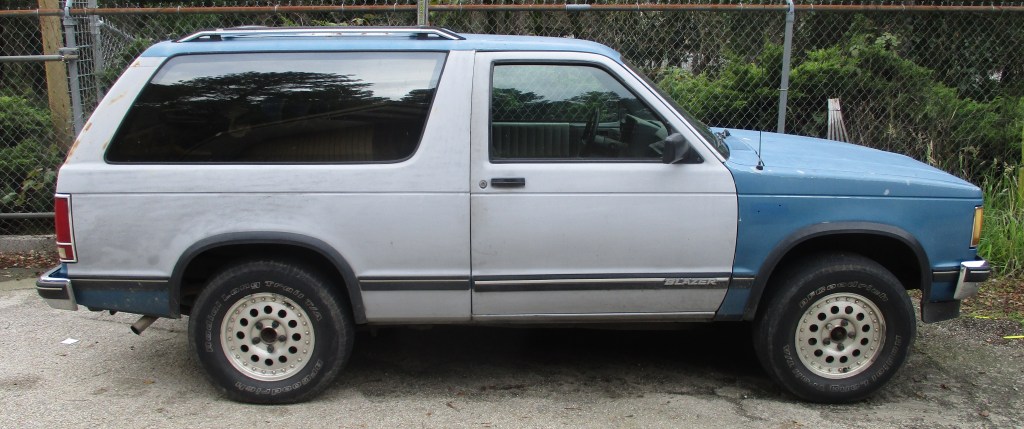
Roy – Obituary

Roy T-10 Blazer Chevrolet of Felton succumbed to complications associated with a blown head gasket, and passed away on December 16, 2019, near his home, at the age of thirty. Born in about January of 1989 in Shreveport, Louisiana, and purchased immediately afterward at Los Gatos Chevrolet, Roy lived most of his life at the same stable home in western San Jose. He graciously parked in a driveway so that a younger Honda Accord could park inside the garage, next to a pile of junk that occupied another parking space that Roy silently coveted. It was there that he began to develop peeling paint, which afflicted him for the rest of his life. When his only former employer relocated to Ohio in the summer of 2012, and the Accord went to live with a neighbor, Roy came to live in Felton, near Zayante and in Brookdale. Shortly after arrival in Felton, Roy made the epic journey to Newalla in Oklahoma for which he became famous. More recently, he made more trips to Beverly Hills than he should have been expected to make after so many years and miles of reliable service. During one such trip, Roy met the young convertible, Lee Sebring Chrysler, who relocated to Felton to be with him. Sadly, Lee preceded Roy in death. Roy was something of a nonconformist. He was like public transit for those who lack transportation or are unable to drive. Most considered him to be a truncated station wagon. To others, he was a diminutive modified pickup. To Bill the terrier, who was promised an Oldsmobile, but could neither perceive color nor read what was so prominently printed on his tailgate, Roy was the ‘red Bravada’. Most importantly, Roy was here to take so many of us where we needed to go.

Cost of Living

While looking at real estate in Oklahoma, it is apparent why homelessness in not so prevalent there. It is probably similar to many other places in America. Perhaps it is more accurate to say that this region and a few others are not so similar to the rest of America. After all, there are more of those places than there are of these. They are what is more normal. This is not normal.

It is easy to imagine that harsh climate would be a deterrent to homelessness. It probably is to transient homeless people who migrate to climates that are more conducive to homelessness. However, there really are not many homeless people who are transient, even here. Almost all homeless people live in their respective Communities, where they were before homelessness.

The cost of living is more relevant to homelessness than climate. There are not as many homeless people in Oklahoma simply because rent and real estate is so much more affordable there, even relative to the lower regional average of wages. Many more people who want to purchase a home can. Just about anyone with an average job can afford the regionally inexpensive rent.

Another dynamic that is not often considered is that people in Oklahoma and many other regions can live on their own property, even without what would be considered to be a habitable or ‘compliant’ residence. Those who own property might live in recycled mobile homes that may not comply to local building codes. Some might live in less than that, rather than be homeless.

There would be so much less homelessness in some parts of California if that were possible here. Some of the homeless in Felton own undeveloped and otherwise useless parcels that could accommodate all of the few who presently remain homeless here.

Frio de Ausencia

‘Cold of Absence’. That is the direct translation. Is sounds prettier in Spanish, perhaps alluringly exotic. In reality, it is a sad song of unrequited love, composed by Gali Galeano of Columbia in 1981. I knew none of that until I looked it up online a moment ago. I knew ‘Frio de Ausencia’ only as the name of a tired old Chevrolet on a farm I worked on after I graduated high school.

No one knows why it was named ‘Frio de Ausencia’. I asked. The name was painted in black letters across the front of the gray hood. It makes no more sense to me all these years later than it did then. I do miss it though. It was such a simple and somehow stylish old pickup, at a time when contemporary vehicles innately lacked such qualities. It did anything we needed it to do.

I went off to college and never saw Frio de Ausencia again. A young man whom I worked with, who was a few years older than I was at the time, took it with him when he relocated to Gilroy. Everyone else I worked with there that summer is now deceased. The farm was developed into a tract of homes, where many more people are now enjoying their respective place and time.

In this place and time, here and now, absence is something we often notice. It is not necessarily cold though. Over the years, some of us have relocated for employment or more comfortable domestic situations. Some of us who are still here are too busy with resumption of careers and domestic lifestyles to socialize like we did when we lacked to some degree in such obligations.

As much as we might miss our friends, and notice their absence, it is gratifying to know that they are generally much happier and healthier than they were before improving their respective situations. Such absence is a tolerable consequence of progress. As silly as it might seem to those unfamiliar with our society, we would rather notice their absence than enjoy their presence.

Apologies for the delay of posting an article this week. It became necessary to postpone the topic I started writing about.

Rainy Season

The first storm since spring left more than an inch and a half of rain by the time the sun came up on Wednesday morning. Rain that started with the second storm that arrived this morning, and is still falling as I write this, is expected to continue through Monday, followed by showers through the foreseeable forecast. The dry summer is over. It is now officially the rainy season.

Are we concerned about those lacking adequate shelter? Well, of course we are. It is terribly uncomfortable and potentially dangerous to be out in the weather when the weather is like this. Those who live out in forested areas are vulnerable to falling limbs and trees, as well as potential flooding. While cold and wet, it is more difficult to recover from illness, or just avoid illness.

However, the situation is not as bad as it could be, or as bad as it was years ago, when there were many more of us without homes, and lacking resources. This season, there are fewer of us lacking shelter than there have been in a very long time. The same resources that have always been available are still there for those who need them. More of us have resources of our own.

We must still watch out for each other. This is just the beginning of what will become a more difficult rainy season. When it does not rain, it will likely be cold. That is just how weather works. At least we happen to live in a relatively temperate climate. It does not get as rainy as Western Washington, or as cold as Minnesota. We will get through it as well as we somehow always do.

Perhaps, this year, we will get through the rainy season even better than we typically do.

Misconceptions – Homelessness Is A Growing Problem

Homelessness in America has been increasing very slightly for the past three years. It has been increasing in parts of California for a bit longer, and at a slightly more accelerated rate. More substantial increases are concentrated mostly in urban regions, particularly Los Angeles, San Diego, San Jose and San Francisco. Homelessness really is a growing problem, at least for now.

However, for the decade prior to the the relatively recent increase that began only three years ago, homelessness had been decreasing at a substantial rate. Furthermore, the substantially increasing rates of homelessness in urban regions of California are sufficiently offset by decreasing rates in suburban and rural areas, to average out to only a minimal increase for the state.

This is not about homelessness in all of America though. Nor is it about homelessness in the rest of California. Here in Felton, the rate of homelessness has decreased significantly in the past seven years since 2012. Only a few people became homeless here during that time, and most of those were not homeless long. Several more who had been homeless have since found homes.

So, why do haters so regularly and predictably complain that homelessness is a growing problem in Felton? Well, that is part of what they do. They perpetuate false information intended to vilify their targeted victims, and exaggerate any innate problems associated with them. They strive to be a divisive force within an otherwise remarkably cohesive and inclusive Community.

No verifiable statistical information is necessary for a hater to claim that homelessness is a growing problem in Felton. Conversely, any observant and sensible person can plainly see that it is not. If homelessness really had been a growing problem since 2012, there would be more homeless people in town rather than less. It is that simple.

Misconceptions – Immigration

‘Misconceptions’ could become another category for this blog, like ‘Hypocrisy’. There is quite a bit to write about that could be categorized as such. It would be more relevant and interesting than the ‘Hypocrisy’ category, especially if the ‘Hypocrisy’ category is eventually deleted, as has been suggested. Furthermore, ‘Misconceptions’ would be less objectionable than ‘Hypocrisy’.

‘Immigration’, for example, is an interesting topic that is unobjectionably relevant to homelessness, but only because of the misconception that most homeless people here immigrated with the intention of being homeless. This misconception is obviously perpetuated by those who are not very acquainted with homeless people, particularly the local homeless residents of Felton.

There are certainly more homeless people in California than elsewhere. There should be. There are more people of all sorts in California than elsewhere. California is the most populous state. Because real estate here is more expensive than all but only a few other places in America, a disproportionate ratio of those who live and earn income here can not afford a mortgage or rent.

Most homeless people in California lived here while they were not homeless. They payed mortgages and property taxes or rent just like anyone who lives in a home. Some payed significantly more than average. Most had gainful careers here. Some raised families here. Sadly, some who are homeless are in the process of raising their families. Some have never lived anywhere else.

Of the few homeless people presently in Felton, only one immigrated from outside California less than a decade ago, early in 2013. Only one immigrated from outside America, but did so for work in the early 1990s. All others are Californian, and have been in Felton for many years. More than half are native to the San Lorenzo Valley. More than half formerly owned homes.

Thesaurus

Those of us who write sometime find a thesaurus to be useful for suggesting synonyms, euphemisms or similar alternatives to words that we are trying to avoid the use of. Synonyms might be useful to avert the redundancy of using a particular prominent word a few times in a single paragraph. Euphemisms might be less objectionable synonymous options to unpleasant words.

A thesaurus does not directly define words like a dictionary does, but by providing words of similar meanings, a thesaurus indirectly demonstrates how words are perceived by society. Such perceptions may be significantly different from actual definitions. Some may be completely inaccurate. Some synonyms, whether accurate or not, are potentially objectionable dysphemisms.

A comment in one of the newspapers I work for in Southern California described those who lived in homes destroyed by the Getty Fire as ‘outside the gates’. It took me a while to determine that this is a polite way of saying that they are homeless. To me, it seems to be more exclusionary than polite, but I have never tried the phrase. It prompted me to inquire with a thesaurus.

‘Homeless’ was the basic word I inquired the thesaurus about. Some alternatives are actually phrases that are too cumbersome to substitute for a single word.

“houseless, unhoused, displaced, unplaced, unestablished, unsettled” are simple euphemisms. Some of us are familiar with the first few.

“wandering, itinerant, vagabond, vagrant” are words that describe those who are transient, so do not apply to any of us who live here.

“destitute, estranged, desolate” could be accurate for some of us, although not contingent of homelessness. The last one seems . . . odd.

“derelict” seems to be more relevant to a carcass of an old Pontiac.

“disinherited, dispossessed” are more relevant to relationships with family and friends than a domestic situation.

“exiled, banished, outcast”?! We are not political refugees! (Okay, one of us is.)

“unwelcome, forsaken, friendless, uncared-for”?! How are these words even relevant to our respective domestic situations? Furthermore, how can any homeless (or houseless or unhoused or displaced or . . . ) person experience any of this here in our remarkably welcoming and caring Community of friends in Felton?!

Chili Cook Off

The Sixth Annual San Lorenzo Valley Chili Cook Off yesterday at Felton Covered Bridge Park was a fund raiser hosted by Felton Library Friends to benefit the new Felton Library and Nature Discovery Park. That is why tasting kits that were needed to participate were sold for $5. All of those $5 charges were collectively the funds that the fund raiser raised.

Of course, there was much more to it than that. No one would have attended if it was just about collecting funds. It was about a good time, with food, beverages and live music. A dozen or so chili chefs competed for prizes. Local business donated even more prizes for a raffle later in the day.

Contestants, volunteers and just about everyone who attends such events knows how to have a good time. $5 is a trivial charge to participate. Not many who pay put much though into it as contribution to fund raising. Procurement of resources for the Felton Library and Nature Discovery Park is very important, but so is doing the event right.

For several, doing the event right entailed including those who had neither the intention of participating, nor the minimal resources to do so. They delivered several and various bowls of chili to a few of us who were gathered at the picnic table closest to the parking lot. That is being seriously Community oriented!

I know this is not the best picture of a bunch of empty bowls and a few that I snatched from those who were still eating out of them, but it shows the variety of the chili. These were not contributed by one chef who wanted to lighten his load of leftovers, but from at least six different chefs. There were more empty bowls that had already been discarded.

Hypocrisy – A Predictable Pattern

Haters who stalk us are predictable. Their techniques are so similar. It is as if they all study the same standardized instruction manual for proper techniques of hatred, as well as hypocrisy.

For example, they all engage in stalking of some sort, in order to find information they can use to either irrelevantly shame their victims, or modify for the same effect. If they find nothing of interest, they lie to create scandal regarding fictitious nefarious behavior. Yet, anyone who questions them about their own similar but real and observable behavior, they accuse of stalking.

Some of us, years ago, were pursued by haters who took photographs of us to post and ridicule online. When a few of us photographed those photographing us, we were accused of stalking. The difference with how such photographs were obtained is that they were pursuing or stalking us, but we were not pursuing them. We merely photographed what was in our surroundings.

Furthermore, while they falsely accused us of all sorts of bad behavior that they somehow never got pictures of, we merely posted their pictures with explanations that they were taking our pictures. We did not lie about their activity when sharing pictures of them online. Yet, they insisted that posting pictures of them (as they took pictures of us) was some sort of harassment.

Stalking and harassment; so what about bullying? Haters are experts. However, any victim who so much as questions the need or relevance of their bullying is promptly accused of bullying. It is such a reliable pattern. Haters accuse their victims of their own behavior.

Many years ago, one of our friends investigated this pattern of behavior beyond direct correlations of discussion on social media, and into other publicly available information. After noticing that a particularly vocal hater repeatedly ranted about how the homeless exploit the resources of social services, he found that she had been prosecuted for fraud of Workers’ Compensation.

A similar observation was made in regard to a hater who regularly ranted about how homeless people who can not afford to live here must move away. While her home was on the market, one of our friends who had briefly considered purchasing it, realized that it had been in pre-foreclosure for more than a year. This pattern is so reliable that it prompts its own investigation.

While on Facebook, a neighbor noticed one of the familiar haters accusing someone else of establishing a ‘GoFundMe’ account, in a rather demeaning manner, and for no particular reason. Of course, he was compelled to search ‘GoFundMe’, and too predictably found that the accusatory hater had established at least two accounts, and her young daughter had established another.

There is certainly nothing wrong with establishing a ‘GoFundMe’ account when necessary.

A few of us know that pre-foreclosure is nothing that anyone actually chooses to be engaged in.

Even a fraudulent claim of Workers’ Compensation funds is nothing to be judged too harshly. Mistakes happen. Workers’ Compensation claims adjusters do not always agree with physicians.

However, the predictable pattern of haters attempting to shame others for their own behavior is hypocritical.