“STAY AT HOME”

The font of the sermonette on the other side is too small to get a good picture of.

That is an order! . . . but not just any order. It is an official California State Order. Most of us have been doing rather well with it from the onset. Many of us are unable to go to work anyway. We might be catching up on some of the many chores we have been neglecting, and maybe wondering how to pay the bills if our income stops. It is a uniquely troubling time, to say the least.

What about those of us who lack homes? Avoidance of others is facilitated by so many others staying at home where they belong. Otherwise, social distancing is the best we can do. Even that is quite difficult for those who live in very close proximity to others in the same situation. Because of the trouble of storing what we need, we must shop for food more frequently than others.

Larger Communities, such as Santa Cruz, are attempting to shelter more of those who lack shelter, particularly those who are classified as ‘high risk’. Hotels should be commended for their cooperation with this endeavor, and for providing uncrowded individual accommodations to the elderly! Many prefer to avoid crowded shelters where practical social distancing is impossible.

Lunches at both Felton Presbyterian Church and Saint John’s Catholic Church can not be served to our significant groups, although Felton Presbyterian Church continues to provide bagged individual lunches. As their flier in the picture above indicates, showers at Felton Presbyterian Church have been canceled. Fortunately, we have other meager resources, and adequate food.

We know how to work with limited assets.

News is confusing. We all know why it is so very important now though. There is no need to say so. Nor must we read about it in the flier above. There are plenty of other credible resources.

Actually, the font is not all that bad.

Better Homeless Gardens

‘Better Homes & Gardens’ appeals to those with homes and perhaps associated gardens that are, well . . . better. It also appeals to those of us who would prefer our homes and gardens to be better than they presently are. Those of us who lack home or garden space are likely more concerned with basic survival than the latest fads and trends of contemporary domestic lifestyles.

Of course, that does not dictate that none of us are interested in domestic issues or gardening. Every one of us has lived in a home at one time or another, and intends to do so again. Many of us have likewise enjoyed gardening, and intend to do so again. In fact, a few of us presently enjoy gardening without our own garden spaces. Some of our gardens are remarkably productive!

Garden spaces are are not as difficult to procure as domestic situations are. Some of us who reside in homes but do not enjoy gardening are pleased for others to utilize some of our otherwise unused garden space, rather than allow it to remain fallow. Some even consider the cost of water consumed by a garden to be worth the incidental management of unwanted wild vegetation.

This happens to be the time of year for warm season vegetables to get started for summer and into autumn. None of us really need to grow any vegetables. We have access to more than we need from food distribution and donations. We just enjoy growing a few vegetables that are not commonly provided by the typical sources, such as tomatoes, green beans, peas and corn.

Some of us just enjoy gardening for the sake of gardening, and share the vegetables, fruits and even a few flowers with anyone in the Community who appreciates the produce.

Writer’s Block

It is now getting late on Sunday night. Nothing is written for this week yet. It will be a stretch to get these next few paragraphs written and posted before midnight.

I can formulate all sorts of excuses for my very late start. I really am ridiculously busy. However, the real reason for the difficulty of writing something for this week is very literally not very interesting. There are literally not many interesting topics to write about.

The weather is excellent.

Everyone is getting enough to eat.

Many of us who formerly lacked homes have procured habitation.

Many of us who had been unemployed have procured employment.

The Community is amazingly generous and supportive.

Even our pet companions have it pretty good.

This is getting to be redundant. I have repeated some of this information a few times in the past several months. The good news is that this is all good news. The bad news is that it is not very interesting after reading about if a few times.

In the past, there had been more interesting bad news to write about. It is scarce now.

Some have recommended that I write more about homeless culture and society. Some have expressed interest in brief biographies of members of the homeless Community. Such topics are not so easy to write about without compromising the privacy of those involved.

For a blog that evolved from a social network that originally exposed unfounded persecution and discrimination of the homeless, a lack of subjects to write about is a good thing.

I suspect that there will be a few new pleasant topics to write about this year. It is still too early to discuss some of those topics. It is not easy to wait for them.

Now, I will post this before midnight.

Dixie and Associates

Dixie was such a princess!

Dixie has been gone longer than most of us realize. She passed away two years ago on February 18.

She certainly was the princess of her empire. Her dedication to her regal obligations was exemplary.

Of course, her species is famous for their dedication. That is why they stay with us when things get difficult.

Only a few years after losing the person she had always lived with, and the home that they shared in Boulder Creek, Dixie lost her second home south of Felton. She adapted and continued with her duties until the very end.

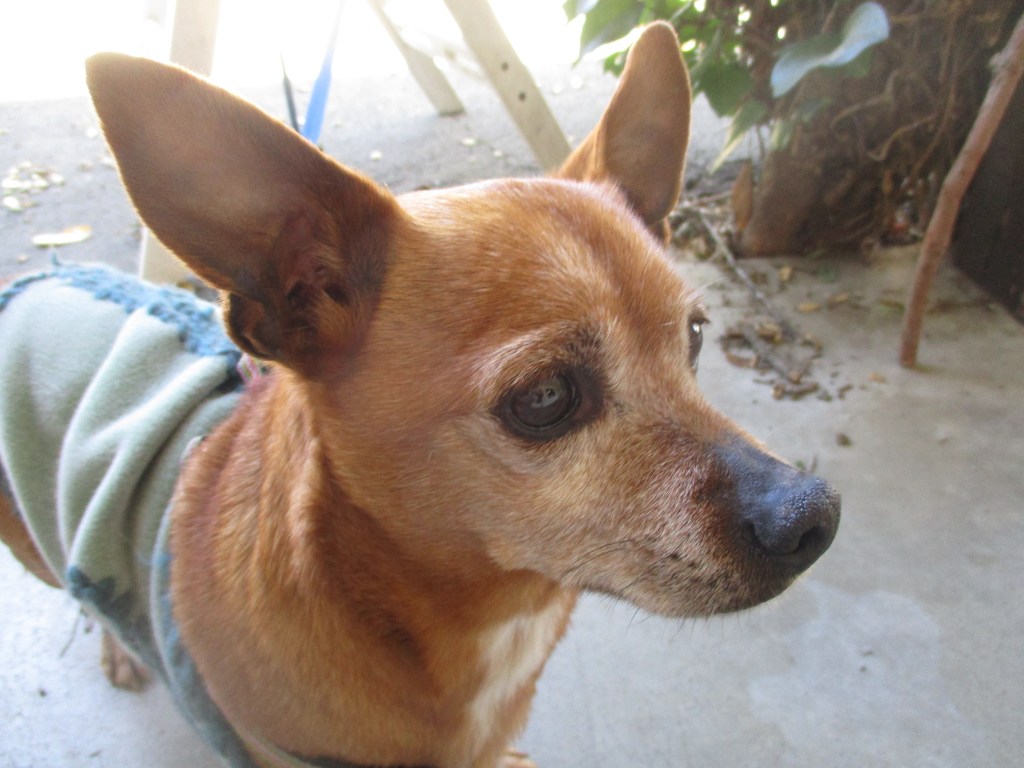
Gala is a gingerbread dog, and frosted around her muzzle now.

Galadriel, whom most of us know as Gala, spent most of her life in a comfortable home with a spacious fenced back yard. She does not miss it as long as she is with the person she has always lived with. The same applies to Meggy Mae, who has traveled to other towns and even Idaho as the person she lives with pursued employment.

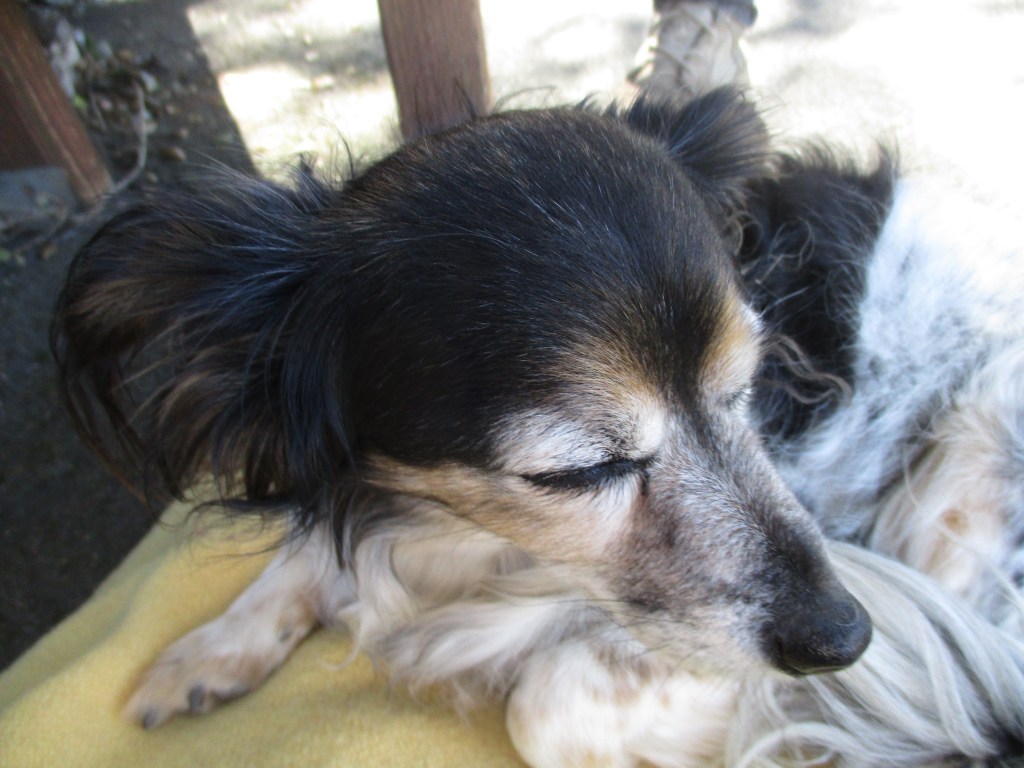
Meggy Mae is a bit slower these days, but is as distinguished as she ever was.

Some of our companions lack permanent homes. Others live in comfortable homes and even in other towns, but come to visit enough to be integral components of our Community.

Peewee lives a comfortable life in Bonny Doon.

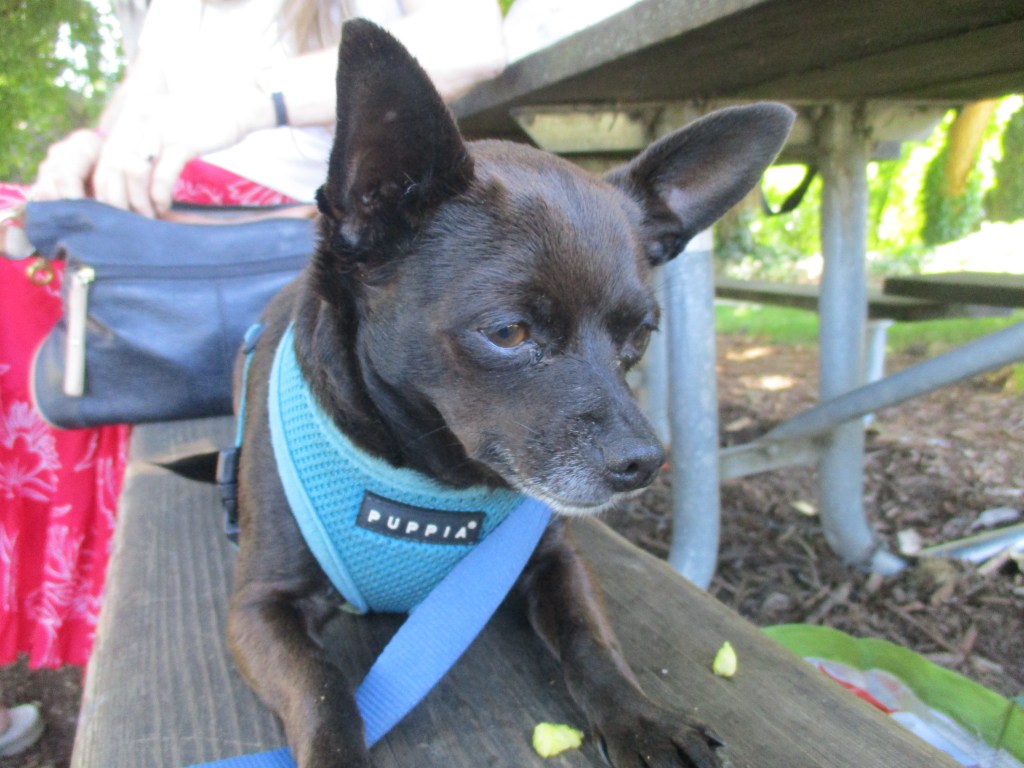
There are too many to get pictures of them all. Buddy is a stout rat terrier and chihuahua hybrid who had relocated to Gilroy and Morgan Hill for employment of his person, but is back in town now. Loki, a spitz, lost his person and their home several years ago, but now lives quite comfortably in Boulder Creek.

Buttercup lost the person she had always lived with, and their home, but is now in a new home with a new family.

It is very difficult for everyone involved when a companion must live with other people in another home while his or her primary family is without a home. Most of the companions of those who lack homes within our Community have been very fortunate to be able to remain with their primary people.

Moose often visits from Boulder Creek.

Discrimination Never Gets Old

Indigenous People of North America were perceived to be primitive barbarians by the first Europeans who encountered them. Some of European descent wanted to civilize them. Some just wanted them out of their way. Few had much regard for their culture. By the time modern American culture evolved enough to appreciate what was here before, the damage had been done.

People from Africa who were sold as slaves through almost two and a half centuries of American history were similarly considered to be primitive barbarians. Much of society justified their exploitation, but then wanted them segregated after their emancipation. American culture should have evolved beyond discrimination against those of African descent by now, but it has not.

Although technically not enslaved, American immigrants from China were exploited for their willingness to perform very demanding and often very dangerous manual labor for minimal pay. Yet, they were systematically discriminated against. Many were compelled to reside in neighborhoods on floodplains of cities they inhabited, merely because no one else wanted to be there.

There are too many examples of social discrimination in American history to list. The worst of them are difficult to comprehend. We like to think that, although American society engaged in such abhorrent conduct in the distant past, such discrimination could not be repeated. Yet, Americans of Japanese descent were released from internment camps just seventy-five years ago.

There are always new victims. At a time when ethnic discrimination is less socially acceptable than it had formerly been, it has become easier to persecute, vilify and discriminate against the homeless. Regardless of the original justification for such behavior, the patterns are the same. We are fortunate in Felton that these patterns are not as common as they are elsewhere, and that we recognize the perpetrators for what they are.

Misconceptions – Bus Fare

There’s no place like home. Most of us genuinely and justifiably believe that our respective hometowns are very special. There is no doubt that they really are. We can get a bit overindulgent with such belief though. We tend to assume that social problems of all sorts are worse within our own Communities than they are in other Communities that we do not identify so much with.

No place is perfect. Most towns of significant population in America must contend with some degree of poverty, unemployment and homelessness nowadays. Even more contend with some degree of crime. Addiction has become an epidemic. Mental illness continues to proliferate. Conservatives blame liberals. Liberals blame conservatives. Lions and tigers and bears, OH MY!

To make matters worse, some believe that other Communities, both near and far, send the less fortunate of their respective societies here. Such Communities supposedly compel those who benefit from their generosity and willingness to assume the expenses of travel, to board airplanes, trains and buses to Felton. Communities within minimal proximity purportedly use Uber.

So, . . . where are they? Where are all those who arrived at the train station or airport here in Felton from somewhere else? Where are the airport and train station? Of those who ride local buses or use Uber, who got just one of their fares paid by another municipality who wanted them to leave? We are acquainted with all of the less fortunate here. These are simple questions.

When we help someone from here get to somewhere else, it is only because of some sort of opportunity at the destination, such as employment or a domestic situation. If the less fortunate of other Communities come here, it is likely for the same reasons. They are now likely employed and living in homes.

Liberalism Is A Mental Disorder

Michael Savage wrote the book. It is supposed to be well worth reading. I have never done so. Nor do I intend to. I know I would not enjoy it. My prejudice is not based on what I believe the book to be about. It is derived more from the expectation of an objectionably straightforward presentation of accurate but unpleasant information that really should be common knowledge.

Yuck!

Conservatism is not perfect either. If extremist liberals could compose more than a few coherent sentences, one might write a book about it. Neither conservatism nor liberalism is the worst of the many social complications that those who identify with one but most definitely not the vilified other should be concerned about though. Extremism is what enhances the worst of both.

Homelessness and all the problems associated with it are social problems. They affect all of society. They are neither liberal nor conservative. Yet, extremists so readily blame politicians for causing such problems or allowing them to continue, as if they do so intentionally. Conservative extremist blame liberal politicians just like liberal extremists blame conservative politicians.

How many of those who blame others for homelessness actually do anything about it? Do any of them help the homeless procure domestic situations? Do any of them help the unemployed procure employment? Do they donate food or clothing to those who are in need of such resources? It seems that most are pleased to continue to complain about what others are not doing.

Fortunately, there are many within our Community who are very supportive in regard to helping the homeless, unemployed and needy. We do not hear much from them because they are not so unconstructively outspoken. They do not so blatantly blame others for problems that they are not willing to help out with.

2020

This should be a good year for us. It seems that every year of the past several has been a bit better than the previous. It is getting to sound redundant. In our small Community, the rates of homelessness and unemployment are decreasing. There are fewer becoming homeless than there are homeless procuring domestic situations. More are procuring employment than losing it.

We should be grateful. Although this has been the trend nationally, it is not the trend everywhere. Rates of homelessness have increased significantly in many Communities, particularly the more populous cities and towns of California. Homelessness in Los Angeles is beyond deplorable. Increasing employment does not help much while the cost of living exceeds typical incomes.

We do what we can with what we have to work with here, and slowly but surely, it is effective.

In February, some of us will be harvesting and selling madrone and oak firewood from a parcel that would benefit from major vegetation management. Burls of the younger madrones can be harvested and sold as well. The trees will be removed so that fruit trees can be installed next winter. It is not the most lucrative of work, but will more than pay for the pickup used to do it.

It is a start. There are a few more tanoaks to harvest in Brookdale after that, and then mixed oaks and some madrones outside of Scott’s Valley. For those involved, it will be gratifying to get back to work, even if it is only temporary before returning to work within former or other preferred professions. It will be even more gratifying if those who lack homes earn enough for rent.

It is still too early to discuss some of the other potential opportunities for employment this year; but there will be more.

GREEN

GREEN, Greening Residential Environments Empowering Neighborhoods, will be planting at least fifty-two street trees in Los Angeles in less than three weeks, on January 18. Sadly, none of us will attend this year.

Only one of us attended the first tree planting project by GREEN twenty-two years ago. One may not seem like an impressive number, but it was half of the two who started what has become an annual tradition. Back then, we were committed only to plant thirty trees, and then planted about twice that many by the time the project was completed.

Now that GREEN has organized an impressive crew of local volunteers, it is not so important for any of us to go all the way to Los Angeles to help. Besides, we can be more helpful here, by growing some of the trees that GREEN will eventually plant.

After all, the first large groups of trees, as well as a few individual trees, came from here. In fact, on West 21st Street, between South La Brea Avenue and (coincidentally) South Sycamore Avenue, there might be as many as four sycamores that were grown from suckers that were removed from the massive sycamore in Felton Covered Bridge Park.

It would be nice to grow more sycamores because they are remarkably complaisant as street trees where parkstrips are wide enough. They do not get as big in such exposed situations as they do here. They are easily grown from cutting, and can be passively field grown on a vacant parcel in Brookdale, to be dug and relocated bare root to Los Angeles.

Deodar cedars would be nice for a section of Masselin Avenue in the Miracle Mile District. We happen to have access to a significant herd of feral seedlings here that need to be removed. The problem with them is that they can not be so passively field grown, so must instead be canned and irrigated. Bulky canned trees are not as easily delivered to Los Angeles as bare root trees.

There is plenty of space available for such a crop. There is plenty of water, growing media and cans. Even labor is not lacking. The difficulty will be getting all the assets together. Most of us do not get very far from Felton. The best space available for such projects in past Zayante or outside of Scott’s Valley. Available space that is closer lacks water for irrigation.

We will figure something out. We typically do. The young cedars will not occupy so much space during their first year, so can probably stay in Felton. More space will likely become available by the time we need it. If the finished crop does not fit into one pickup like more than sixty manna gums fit into one station wagon, we can simply rent a moving van. We will make it work.

Note: Metro Rail was not built into the medians of San Vicente Boulevard as described in the article ‘Birthday Trees’, so many of the original trees remain.

Roy – Obituary

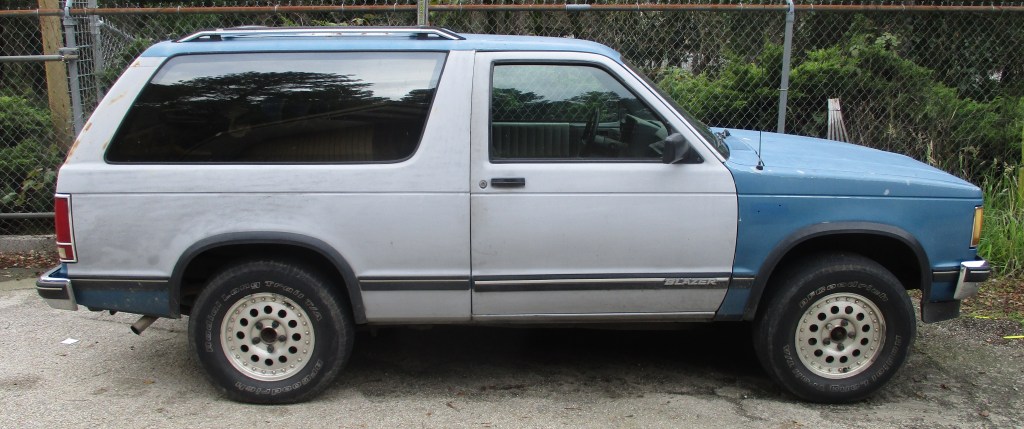
Roy T-10 Blazer Chevrolet of Felton succumbed to complications associated with a blown head gasket, and passed away on December 16, 2019, near his home, at the age of thirty. Born in about January of 1989 in Shreveport, Louisiana, and purchased immediately afterward at Los Gatos Chevrolet, Roy lived most of his life at the same stable home in western San Jose. He graciously parked in a driveway so that a younger Honda Accord could park inside the garage, next to a pile of junk that occupied another parking space that Roy silently coveted. It was there that he began to develop peeling paint, which afflicted him for the rest of his life. When his only former employer relocated to Ohio in the summer of 2012, and the Accord went to live with a neighbor, Roy came to live in Felton, near Zayante and in Brookdale. Shortly after arrival in Felton, Roy made the epic journey to Newalla in Oklahoma for which he became famous. More recently, he made more trips to Beverly Hills than he should have been expected to make after so many years and miles of reliable service. During one such trip, Roy met the young convertible, Lee Sebring Chrysler, who relocated to Felton to be with him. Sadly, Lee preceded Roy in death. Roy was something of a nonconformist. He was like public transit for those who lack transportation or are unable to drive. Most considered him to be a truncated station wagon. To others, he was a diminutive modified pickup. To Bill the terrier, who was promised an Oldsmobile, but could neither perceive color nor read what was so prominently printed on his tailgate, Roy was the ‘red Bravada’. Most importantly, Roy was here to take so many of us where we needed to go.