Dixie and Associates

Dixie was such a princess!

Dixie has been gone longer than most of us realize. She passed away two years ago on February 18.

She certainly was the princess of her empire. Her dedication to her regal obligations was exemplary.

Of course, her species is famous for their dedication. That is why they stay with us when things get difficult.

Only a few years after losing the person she had always lived with, and the home that they shared in Boulder Creek, Dixie lost her second home south of Felton. She adapted and continued with her duties until the very end.
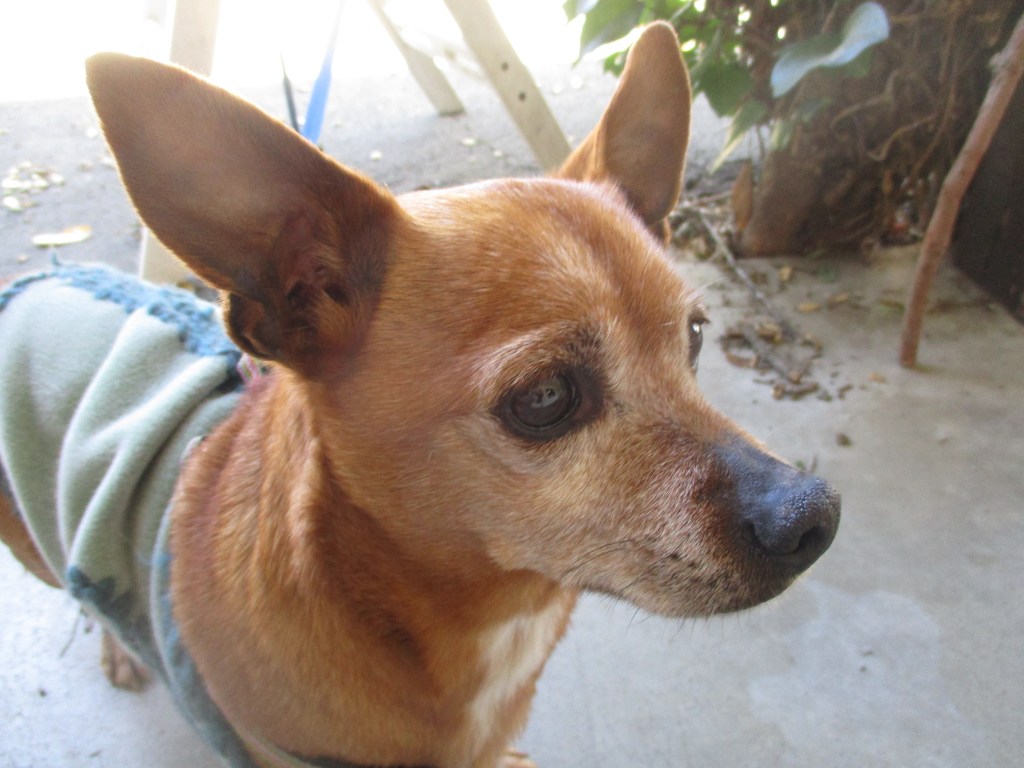
Gala is a gingerbread dog, and frosted around her muzzle now.

Galadriel, whom most of us know as Gala, spent most of her life in a comfortable home with a spacious fenced back yard. She does not miss it as long as she is with the person she has always lived with. The same applies to Meggy Mae, who has traveled to other towns and even Idaho as the person she lives with pursued employment.
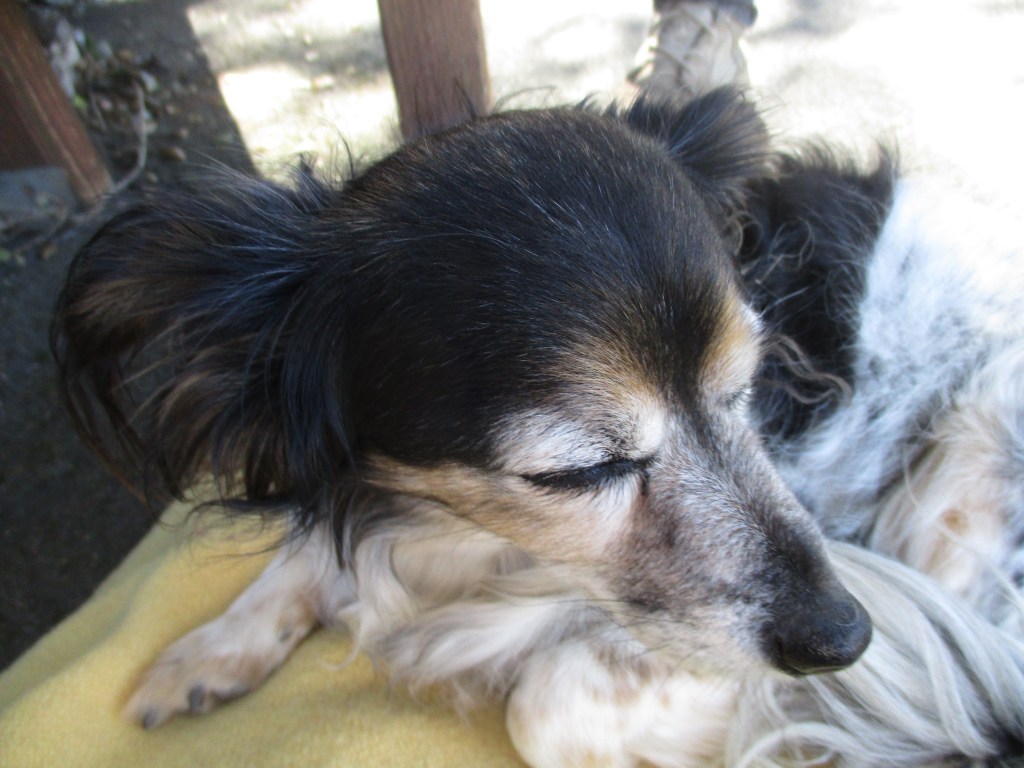
Meggy Mae is a bit slower these days, but is as distinguished as she ever was.

Some of our companions lack permanent homes. Others live in comfortable homes and even in other towns, but come to visit enough to be integral components of our Community.

Peewee lives a comfortable life in Bonny Doon.

There are too many to get pictures of them all. Buddy is a stout rat terrier and chihuahua hybrid who had relocated to Gilroy and Morgan Hill for employment of his person, but is back in town now. Loki, a spitz, lost his person and their home several years ago, but now lives quite comfortably in Boulder Creek.

Buttercup lost the person she had always lived with, and their home, but is now in a new home with a new family.

It is very difficult for everyone involved when a companion must live with other people in another home while his or her primary family is without a home. Most of the companions of those who lack homes within our Community have been very fortunate to be able to remain with their primary people.

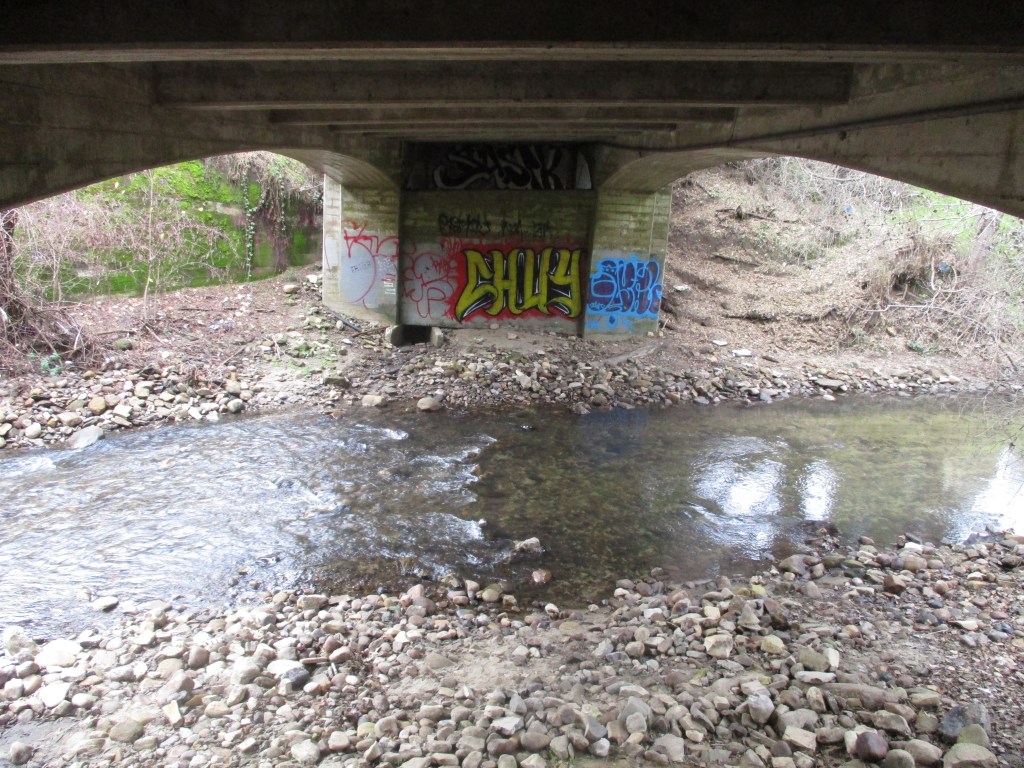
Moose often visits from Boulder Creek.

No Rain

January 22 is the date of the last locally recorded rainfall. That was three and a half weeks ago. There is only about a %25 chance of rain predicted for next Sunday, a week from today. That does not seem too promising. The probability for rain might decrease just as easily as it might increase. Even if it does not change, there is a %75 chance that there will be no rain next week.

Also, temperatures have been unseasonably mild lately, with no more frost expected for the season. In fact, temperatures are not expected to drop below the mid 40s at night anytime soon. Daytime temperatures are expected to be in the upper 60s. Although it would be unrealistic to expect this weather to continue through this last month of winter, it sure feels like spring now.

Flora in the region is expressing its appreciation for, or confusion from, such excellent weather. Acacia dealbata is in full bloom, implying that stone fruit trees will bloom soon too. Apples and pears bloom shortly afterward. Unfortunately, resumption of wintry weather could ruin early bloom and fruit set. There are risks and consequences associates with such delightful weather.

The lack of rain necessitates irrigation of lawns, landscapes and gardens, which is more work for those of us who live in homes. For those of us who lack homes, the same lack of rain negates the need for waterproof shelter. Mild temperatures that are comfortable for those who lack a home to heat at night are potentially detrimental to the fruit that others grow in their gardens.

No one can change the weather. It would be futile to complain abut it. Those of us who can benefit from it should appreciate it while we can. We know that winter is not done yet.

Discrimination Never Gets Old

Indigenous People of North America were perceived to be primitive barbarians by the first Europeans who encountered them. Some of European descent wanted to civilize them. Some just wanted them out of their way. Few had much regard for their culture. By the time modern American culture evolved enough to appreciate what was here before, the damage had been done.

People from Africa who were sold as slaves through almost two and a half centuries of American history were similarly considered to be primitive barbarians. Much of society justified their exploitation, but then wanted them segregated after their emancipation. American culture should have evolved beyond discrimination against those of African descent by now, but it has not.

Although technically not enslaved, American immigrants from China were exploited for their willingness to perform very demanding and often very dangerous manual labor for minimal pay. Yet, they were systematically discriminated against. Many were compelled to reside in neighborhoods on floodplains of cities they inhabited, merely because no one else wanted to be there.

There are too many examples of social discrimination in American history to list. The worst of them are difficult to comprehend. We like to think that, although American society engaged in such abhorrent conduct in the distant past, such discrimination could not be repeated. Yet, Americans of Japanese descent were released from internment camps just seventy-five years ago.

There are always new victims. At a time when ethnic discrimination is less socially acceptable than it had formerly been, it has become easier to persecute, vilify and discriminate against the homeless. Regardless of the original justification for such behavior, the patterns are the same. We are fortunate in Felton that these patterns are not as common as they are elsewhere, and that we recognize the perpetrators for what they are.

Misconceptions – Bus Fare

There’s no place like home. Most of us genuinely and justifiably believe that our respective hometowns are very special. There is no doubt that they really are. We can get a bit overindulgent with such belief though. We tend to assume that social problems of all sorts are worse within our own Communities than they are in other Communities that we do not identify so much with.

No place is perfect. Most towns of significant population in America must contend with some degree of poverty, unemployment and homelessness nowadays. Even more contend with some degree of crime. Addiction has become an epidemic. Mental illness continues to proliferate. Conservatives blame liberals. Liberals blame conservatives. Lions and tigers and bears, OH MY!

To make matters worse, some believe that other Communities, both near and far, send the less fortunate of their respective societies here. Such Communities supposedly compel those who benefit from their generosity and willingness to assume the expenses of travel, to board airplanes, trains and buses to Felton. Communities within minimal proximity purportedly use Uber.

So, . . . where are they? Where are all those who arrived at the train station or airport here in Felton from somewhere else? Where are the airport and train station? Of those who ride local buses or use Uber, who got just one of their fares paid by another municipality who wanted them to leave? We are acquainted with all of the less fortunate here. These are simple questions.

When we help someone from here get to somewhere else, it is only because of some sort of opportunity at the destination, such as employment or a domestic situation. If the less fortunate of other Communities come here, it is likely for the same reasons. They are now likely employed and living in homes.

Political View

Why do local politician get blamed for homelessness here? Did one of them evict someone from a formerly functional domestic situation, . . . or several someones? Did a local politician cause people to become unemployed and consequently unable to afford their respective mortgages or rent? Did just one politician somehow contribute to anyone else’s personal social dysfunction?

Well, like I said earlier, blame is easy.

Now that the rate of homelessness here continues to decline, will local politicians get the credit? Will anyone thank them for the locally declining unemployment rate? Should there be at least some scrap of acknowledgment of the effort devoted to improvement of local homeless shelters? Will we merely take all of it for granted, and find something else to blame local politician for?

Apparently, gratitude is not as easy as blame is.

Politicians have enough to be concerned about without being blamed for other people’s problems, and being expected to fix them. All they can really do is develop strategies and promote the development of opportunities for others to improve their situations. Implementation of such strategies must be a team effort that includes other governmental officials and the Community.

Yes, the Community. How many of us are willing to rent a vacant studio to someone who has been homeless, perhaps for less than market rates? How many of us would help an unemployed neighbor with overdue bills? Fortunately for our Community, most of us would silently do what we could when necessary. But of course, most of us do not blame politicians for homelessness.

The same minority who blames politicians for homelessness also does the least about it. Their irrational intolerance of homelessness is, individually, their personal problem, which should not be assumed as a problem of those who work for the entire Community.

Misconceptions – Graffiti

Cave paintings might be considered to be some of the oldest examples of what we now know as graffiti. Alternatively, such ancient forms of self expression might have evolved into the sorts of artworks produced by Lester Johnson, Frida Kahlo, Mary Cassatt and Henri Matisse. Perhaps it all developed from the same primitive origins of more than sixty-four thousand years ago.

That is inconsequential now. Works of renowned artists are exhibited in museums. Graffiti defaces infrastructure until it gets painted over, or merely defaced and obscured by more graffiti. Except for several galleries of very compelling local art, and occasional touring exhibits, there are no formal art museums in Felton. However, there is more graffiti than only a few years ago.

Haters often blame the homeless for graffiti, merely because some of the homeless camp in some of the same places where graffiti is prominently displayed. In other words, the homeless did it because they were there. According to that logic, the haters must be responsible too, since they were also there. Otherwise, they would not have seen enough graffiti to blame others for it.

What makes anyone think that homeless people have any interest in the sort of elaborate graffiti that has been appearing around town for the past few years anyway? Homeless people have many more important issues to be concerned with. Drawing attention to their camp sites is not exactly a priority. Nor is spending limited funds on something as unnecessary as spray paint.

Besides, while graffiti has become more common than it has ever been, homelessness has become significantly less common. There are presently only a few homeless people in Felton. Most are not sufficiently agile to get into the situations where most of the graffiti has been displayed.

For some, blame is easier than logic.

Liberalism Is A Mental Disorder

Michael Savage wrote the book. It is supposed to be well worth reading. I have never done so. Nor do I intend to. I know I would not enjoy it. My prejudice is not based on what I believe the book to be about. It is derived more from the expectation of an objectionably straightforward presentation of accurate but unpleasant information that really should be common knowledge.

Yuck!

Conservatism is not perfect either. If extremist liberals could compose more than a few coherent sentences, one might write a book about it. Neither conservatism nor liberalism is the worst of the many social complications that those who identify with one but most definitely not the vilified other should be concerned about though. Extremism is what enhances the worst of both.

Homelessness and all the problems associated with it are social problems. They affect all of society. They are neither liberal nor conservative. Yet, extremists so readily blame politicians for causing such problems or allowing them to continue, as if they do so intentionally. Conservative extremist blame liberal politicians just like liberal extremists blame conservative politicians.

How many of those who blame others for homelessness actually do anything about it? Do any of them help the homeless procure domestic situations? Do any of them help the unemployed procure employment? Do they donate food or clothing to those who are in need of such resources? It seems that most are pleased to continue to complain about what others are not doing.

Fortunately, there are many within our Community who are very supportive in regard to helping the homeless, unemployed and needy. We do not hear much from them because they are not so unconstructively outspoken. They do not so blatantly blame others for problems that they are not willing to help out with.

2020

This should be a good year for us. It seems that every year of the past several has been a bit better than the previous. It is getting to sound redundant. In our small Community, the rates of homelessness and unemployment are decreasing. There are fewer becoming homeless than there are homeless procuring domestic situations. More are procuring employment than losing it.

We should be grateful. Although this has been the trend nationally, it is not the trend everywhere. Rates of homelessness have increased significantly in many Communities, particularly the more populous cities and towns of California. Homelessness in Los Angeles is beyond deplorable. Increasing employment does not help much while the cost of living exceeds typical incomes.

We do what we can with what we have to work with here, and slowly but surely, it is effective.

In February, some of us will be harvesting and selling madrone and oak firewood from a parcel that would benefit from major vegetation management. Burls of the younger madrones can be harvested and sold as well. The trees will be removed so that fruit trees can be installed next winter. It is not the most lucrative of work, but will more than pay for the pickup used to do it.

It is a start. There are a few more tanoaks to harvest in Brookdale after that, and then mixed oaks and some madrones outside of Scott’s Valley. For those involved, it will be gratifying to get back to work, even if it is only temporary before returning to work within former or other preferred professions. It will be even more gratifying if those who lack homes earn enough for rent.

It is still too early to discuss some of the other potential opportunities for employment this year; but there will be more.

Cost of Living

While looking at real estate in Oklahoma, it is apparent why homelessness in not so prevalent there. It is probably similar to many other places in America. Perhaps it is more accurate to say that this region and a few others are not so similar to the rest of America. After all, there are more of those places than there are of these. They are what is more normal. This is not normal.

It is easy to imagine that harsh climate would be a deterrent to homelessness. It probably is to transient homeless people who migrate to climates that are more conducive to homelessness. However, there really are not many homeless people who are transient, even here. Almost all homeless people live in their respective Communities, where they were before homelessness.

The cost of living is more relevant to homelessness than climate. There are not as many homeless people in Oklahoma simply because rent and real estate is so much more affordable there, even relative to the lower regional average of wages. Many more people who want to purchase a home can. Just about anyone with an average job can afford the regionally inexpensive rent.

Another dynamic that is not often considered is that people in Oklahoma and many other regions can live on their own property, even without what would be considered to be a habitable or ‘compliant’ residence. Those who own property might live in recycled mobile homes that may not comply to local building codes. Some might live in less than that, rather than be homeless.

There would be so much less homelessness in some parts of California if that were possible here. Some of the homeless in Felton own undeveloped and otherwise useless parcels that could accommodate all of the few who presently remain homeless here.

Frio de Ausencia

‘Cold of Absence’. That is the direct translation. Is sounds prettier in Spanish, perhaps alluringly exotic. In reality, it is a sad song of unrequited love, composed by Gali Galeano of Columbia in 1981. I knew none of that until I looked it up online a moment ago. I knew ‘Frio de Ausencia’ only as the name of a tired old Chevrolet on a farm I worked on after I graduated high school.

No one knows why it was named ‘Frio de Ausencia’. I asked. The name was painted in black letters across the front of the gray hood. It makes no more sense to me all these years later than it did then. I do miss it though. It was such a simple and somehow stylish old pickup, at a time when contemporary vehicles innately lacked such qualities. It did anything we needed it to do.

I went off to college and never saw Frio de Ausencia again. A young man whom I worked with, who was a few years older than I was at the time, took it with him when he relocated to Gilroy. Everyone else I worked with there that summer is now deceased. The farm was developed into a tract of homes, where many more people are now enjoying their respective place and time.

In this place and time, here and now, absence is something we often notice. It is not necessarily cold though. Over the years, some of us have relocated for employment or more comfortable domestic situations. Some of us who are still here are too busy with resumption of careers and domestic lifestyles to socialize like we did when we lacked to some degree in such obligations.

As much as we might miss our friends, and notice their absence, it is gratifying to know that they are generally much happier and healthier than they were before improving their respective situations. Such absence is a tolerable consequence of progress. As silly as it might seem to those unfamiliar with our society, we would rather notice their absence than enjoy their presence.

Apologies for the delay of posting an article this week. It became necessary to postpone the topic I started writing about.