They seem to be everywhere. Needles, or carelessly discarded used syringes, are supposedly found everywhere, especially where children play, and on beaches.
There is no doubt that carelessly discarded used syringes get into some very inappropriate situations. Nor is there doubt that such syringes are very dangerous because of their potential to inoculate innocent victims with communicable diseases.
However, credible and relevant information about such problems is scarce. This certainly is not because there is any deficiency of information. It is because the credibility and even relevance of available information is limited by certain predictable patterns in how it is discussed on social media. It is impossible to know what to believe.
These are a few examples:
All homeless people are blamed for all carelessly discarded used syringes. Are we expected to believe that all homeless people inject illicit narcotics? Furthermore, are we expected to believe that everyone who injects illicit narcotics is homeless? There are presently only a few people in Felton who are homeless. If every homeless person here carelessly discarded used syringes, and no one else did, it would not be such a serious problem.
No one seems to know exactly how dangerous carelessly discarded used syringes are; but we all talk about them as if they are actively killing people. Has anyone here actually contracted a communicable disease from one? Has anyone died from such a disease? We know that communicable diseases are transmitted by promiscuity, but no one seems to be complaining about it.
The same few but very vocal people constantly find almost all of the carelessly discarded used syringes. I do not know many other people who have ever seen one. I work in landscapes in some of the most notorious neighborhoods in San Jose and Los Angeles, and occasionally in San Francisco and Oakland, but have NEVER found just ONE! Why is the problem so exclusive to those who enjoy bragging about their scores?
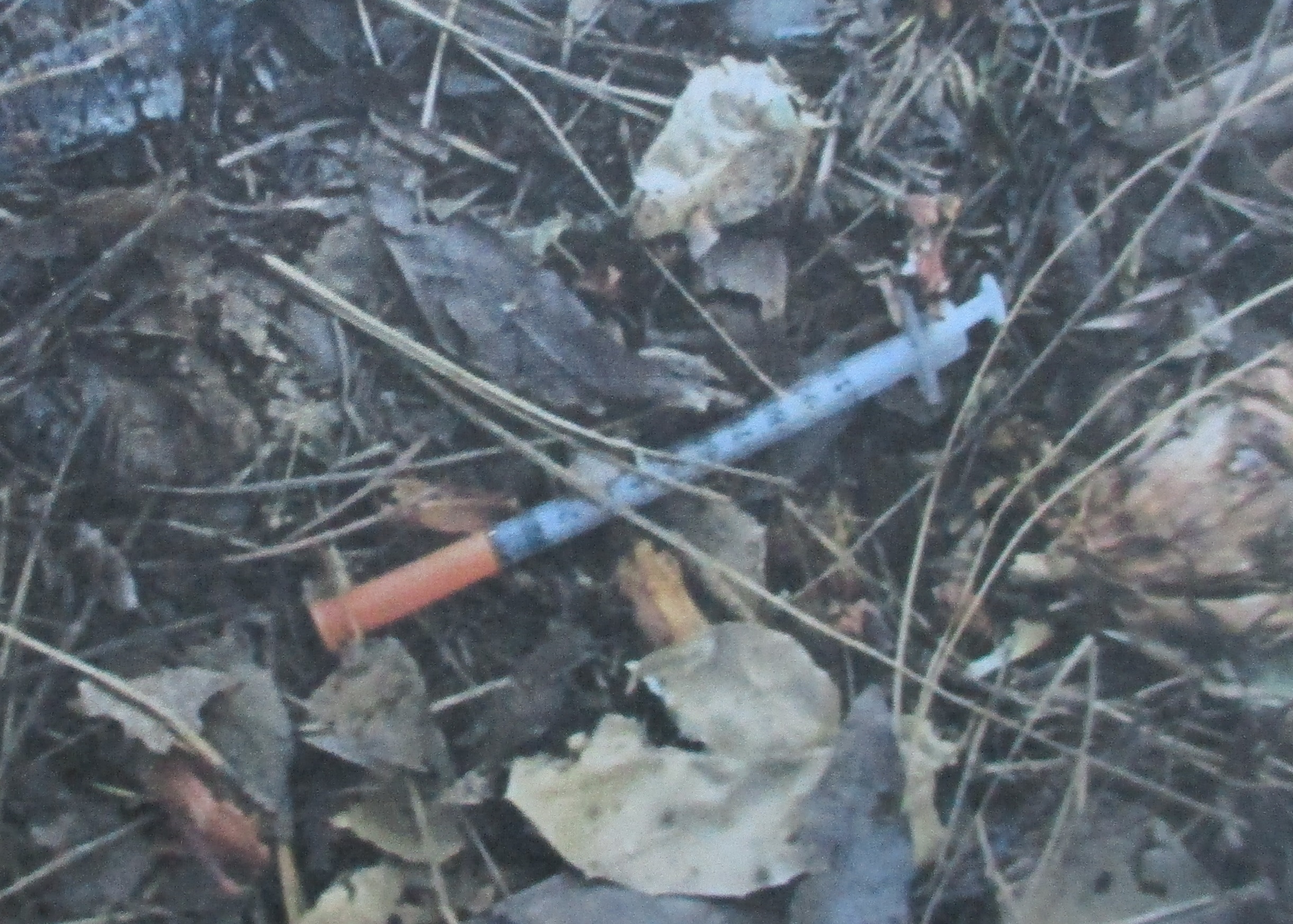
Some of the pictures of carelessly discarded used syringes are simply ridiculous, and sometimes recycled. One such picture that was supposedly taken on the shore of the San Lorenzo River in springtime showed a syringe laying on freshly fallen autumn leaves of quaking aspen, which is not endemic here. Another showed a syringe laying on an outcropping of serpentinite, a geologic formation that is likewise not endemic here.
Law enforcement agencies, such as our Santa Cruz County Sheriffs’ Office, tend to report crime accurately. Those who write such reports are trained on how to do so, so do not embellish with speculation or bias. Because their reports are available to everyone in the Community, they are likely to be confronted with even the slightest of inaccuracies, or anything that can be remotely perceived as an inaccuracy. It can not be an easy process.
Many law enforcement agencies, such as ours, share some of their information about crime on social media. They sometimes ask the Community for information that might be useful for a particular investigation or locating a missing person. Sometimes, they just want to alert the Community to an escalation of a particular type of crime in a particular neighborhood. Sometimes, they merely want to share a bit of what they do to protect and serve.
Unfortunately, as useful as social media and networking is, it is where all the work that goes into accuracy without speculation or bias is ignored, as anyone with any random gripe can respond with disturbingly vitriolic and typically irrelevant accusations, judgments, criticism, threats and name calling. The creativity of such comments is as impressive as the ridiculousness. The unhappiest and most hateful of people have very active imaginations.
Of course, the homeless and societally oppressed are almost always
the victims of their creative imaginations.
When the Ox sculpture in Felton Covered Bridge Park was
vandalized, the homeless were immediately blamed. In fact, Felton
League was implicated specifically, without explanation. What was
even sillier was that after witnessing the crime, one of our
associates went to find someone with a telephone to call for a
sheriff deputy, while another pursued the vandals until deputies
arrived. The vandals, who were not homeless, were arrested.
Yes, there are a few doozies out there.
One of the all time oddest was more than a year and half ago,
when the Sheriffs’ Office described on their Facebook page how they
had apprehended the man who started the Bear Fire by burning down his
home. Someone, who likely has serious issue with the classic ‘chicken
or the egg dilemma of causality’, actually replied to that very same
post by blaming the fire on the homeless!
There is a reason why no illustration accompanies this post. The picture that I wanted to use is just too unflattering.
It is a mugshot of an old friend who had been arrested for trying to get into a car that he believed belonged to his nephew, and then getting combative with Santa Cruz Police Officers who tried to stop him from doing so. He had been missing for three days prior to that, after escaping from the post acute care facility where he lived near the end of his life as he succumbed to a variety of ailments, particularly lung cancer and dementia.
We do not know where he had been or what he had been
doing during those days that he was missing. He could not explain any
of it. He was very tired and very hungry, and looked ghastly by the
time he was found. Fortunately, the Police Officers who arrested him
were quick to determine who he was and that he was missing, and then
return him to the post acute care facility from where he had escaped.
It was an efficient process.
He would have been located much sooner if only the haters had helped. They found his mugshot immediately. Within hours, they had paraded it thoroughly over Facebook and perhaps other social networks, complete with the typical vitriolic accusations, blaming, judging, criticizing, threatening and name calling that they are so proficient and indulgent with. Is dementia really that serious of a crime?
Perhaps it does not matter. To get the process started, haters need only a mention of a crime that includes the names of the perpetrators to find their mugshots online. They often take useful information that is posted on the Facebook page of the Santa Cruz County Sheriff’s Office, and embellish it for their own sadistic entertainment. The rest of us simply want to know about crime in our Community, and maybe, who to be wary of.
After noticing the potential beginning of another display of public ridicule following a post on the Facebook page of the Santa Cruz County Sheriff’s Office a few months ago, a former neighbor questioned one of the main participants in this routine derision, in regard to particular mugshots that she had neglected. This particular hater had always been the most proficient at procuring and exhibiting mugshots for public disparagement.
The hater immediately became hostile to the former neighbor who questioned her, and predictably initiated the typical vitriolic accusations, blaming, judging, criticizing, threatening and name calling that only haters employ to demonstrate their exemplary civility and concern for the Community. Despite her attempts to redirect and end discussion, the former neighbor limited his questions to the topic of the neglected mugshots, but to no avail.
Just as predictably, after failing to dissuade the former neighbor from continuing to ask why the neglected mugshots were not discussed, the hater blocked him from responding, without acknowledgment of the mugshots.
The mugshots in question are of a young lady who had been arrested for DUI (Driving Under the Influence of an inebriant), which really seems like it should be a more serious crime than dementia. I mean, those who drive while inebriated sometimes kill people! However, the young lady who was arrested for DUI is a daughter of another main participant in the routine derision and disparagement of ‘other’ people with mugshots.
It is a standard component of the culture of modern hate groups that target the homeless, as well as every hate group that has tormented society throughout history. I could make a meme of it – ‘Hypocrisy’.
The first hateful comment ever on my gardening blog reminded me of an essay about hypocrisy that was posted on, and then promptly deleted from, the Facebook page of Felton League more than a year ago. It was deleted because someone found it to be objectionable, even after it had been edited for appropriateness of content at least twice. The hateful comment can be found here, as the seventh of the original reader comments (not including replies).
There is not much original material to the essay. It is merely a
collection of seventeen reviews from Yelp, which were written by the
same yelper, preceded by the excerpt that is posted below. Only the
portion that is posted below was written by the author, not by the
yelper who posted the reviews. This portion simply explains the
significance of the seventeen reviews on Yelp. It is difficult to
follow since it was so severely edited here.
The seventeen reviews from Yelp are not included here because they
are not as important as what the original essay is about, which is
clarified in the last paragraph.
If, after reading the excerpt of the essay below, you are
wondering what was so objectionable about the essay, you are not
alone. I should explain that the single person who found it to be
objectionable was the same who wrote the reviews on Yelp. Yes, they
are on Yelp, for everyone to see, but apparently not to be quoted as
seventeen examples of hypocrisy.
This is the excerpt:
This is how haters roll.
ALL SEVENTEEN of these reviews of marijuana
dispensaries are from the same Yelp account of (name
deleted)! Yeah, that’s a lot of marijuana dispensaries for
one person! There could be more that she didn’t leave reviews for.
Four were updated, and one was updated twice. Review #8 says,
“(deleted)” Review
#14 says, “(deleted)”
(name deleted) goes
through a lot of marijuana! By the way, (name
deleted) is (age
deleted) now, so so was in her early teens in the early
1980s when (she said)
she started going to (business
name deleted) that she left review #16 for. She turned
(age deleted) in 1980.
This isn’t the first long list of reviews for
marijuana dispensaries from (name
deleted). She did it on Facebook too, but deleted the
reviews when asked about her marijuana and alcohol use. Yeah, she
also wrote reviews for some of the bars and clubs that she
frequented, and talked jokingly about getting stumbling drunk before
driving home. Yeah, so not something to joke about. Anyway, those
reviews are gone now, and the Yelp reviews pasted here will probably
get deleted too now that she knows that we know who she is. We’ve
known since she left a unique review for one of our friends some
years back. She went by (name
deleted) for a while, and then (name
deleted). FFE keeps a fat file on her.
So, why is this important to us? (name
deleted) publicly accuses all homeless people of constantly
smoking marijuana, and it’s one of many reasons that she and her few
hater friends want the homeless exterminated. HYPOCRISY!
Incidentally, the Yelper who left these seventeen
reviews for marijuana dispensaries supposedly left reviews for four
more marijuna dispensaries just since this essay was posted about a
year ago, although I did not bother to confirm this report. Seventeen
is already way too many for someone who accuses everyone within a
targeted group of excessive use of marijuana.
Fake environmentalism is a HUGE topic, so for now, will be limited
to fake environmentalism as justification for the eviction of
homeless encampments.
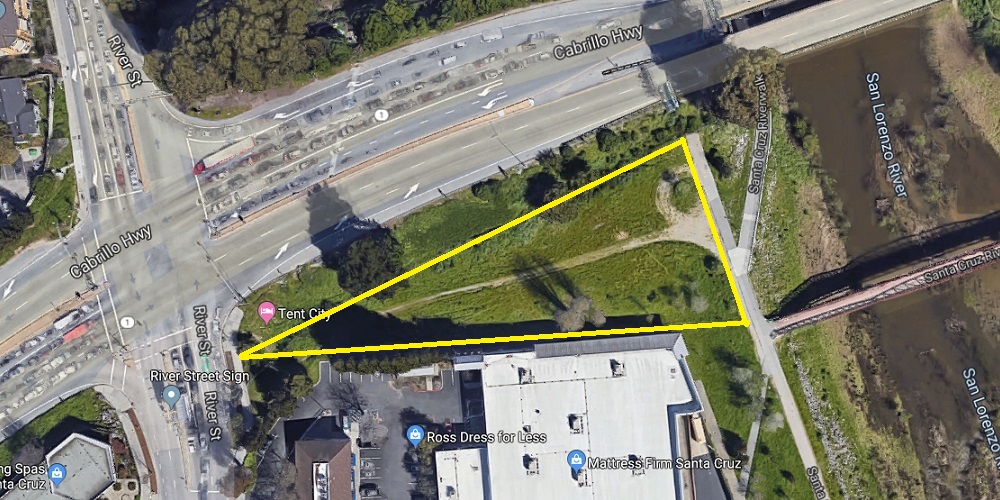
The yellow triangle in the picture above was the site of the
Hero’s Camp, which was more commonly known as Ross Camp, and located
behind Ross Dress For Less in Gateway Plaza in Santa Cruz. It is gone
now. This satellite image was taken by Google Maps prior to the
development of the Camp. I did not get pictures of the camp while
inhabited, but you have likely seen enough other camps in the news to
imagine what it looked like.
It really was as big as it looks, and really did exhibit all the
problems that you hear about in the news, although not to such an
exaggerated degree. Not everyone there used syringes to inject
illicit narcotics. Not everyone there was an alcoholic. Not everyone
was violent, from somewhere else, or a criminal. This is not about
such issues anyway. It is about how the two hundred or so unhoused
people who lived here affected the environment.
Was there trash? Of course there was. Was it more than what two
hundred people who live in homes generate? No. Houseless people do
not generate as much trash as the housed, simply because they lack
resources to purchase the commodities from which so much trash is
generated. The houseless certainly do not waste as much as the
housed. Their trash just happens to be more visible for outsiders who
do not know any better to see.
Furthermore, what is so typically described and perceived as trash
is actually the belongings of those who live in such camps. Without
closets, cabinets or furniture, our belongings would look about the
same, except much more voluminous. When we take just some of the
belongings that we don’t want or need and put them out in front of
our homes, it is a garage sale, and likely amounts to much more than
individual homeless people own.
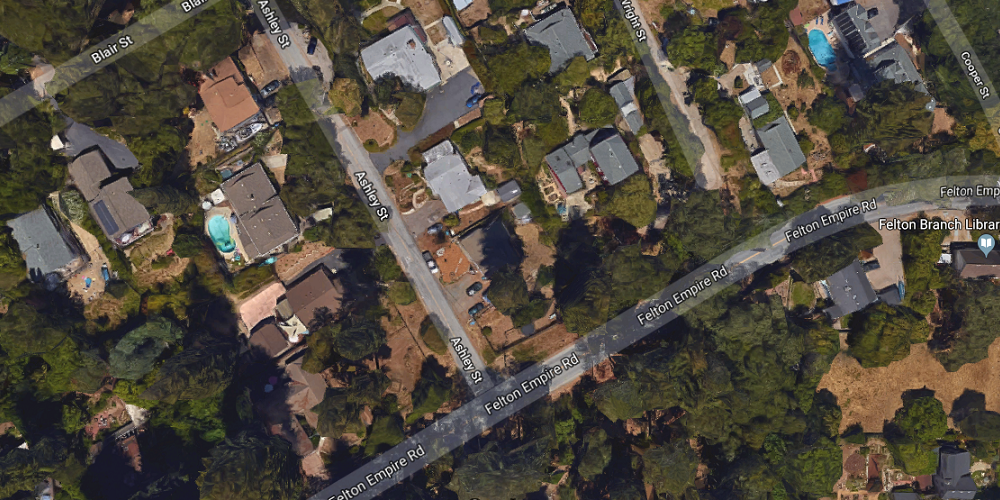
The satellite image from Google Maps below shows the neighborhood
where my grandparents lived in Felton, less than seven miles north of
where the picture above was taken. Their old home is right in the
middle of the picture. There were not so many other homes there when
they arrived, just as World War II was ending. They lived a
relatively modest lifestyle, on a small suburban parcel. They were
not concerned about the environment.
Why should they have been? Even now, the people who live in homes
here can generate as much trash as they want to, and no one will
complain about it. They can fill their homes with their belongings,
and put them neatly away in closets, cabinets and drawers. There are
alcoholics in this neighborhood, as well as a few who are addicted to
illicit narcotics. Some are criminals. Some are violent. Few are
native. Again, this is off the main topic.
None of that is visible in this satellite image anyway. What it
shows instead is how the lifestyles of those who live in homes are
more detrimental to the environment than the lifestyles of those who
lack homes. This picture is the same scale as the picture above, so
you can see that only a few homes would fit into an area comparable
to that in which about two hundred unhoused people lived. Only a few
people live in each of these few homes.
What that means is that two hundred people like those who lived at
the Hero’s Camp live dispersed over a much larger area, on land from
which trees and vegetation needed to be removed. They all live in
homes that are made of wood derived from trees that grew in forests.
These homes are furnished with synthetic plaster, carpet, paint,
glass, vinyl, metals and all sorts of materials that needed to be
quarried, processed or manufactured.
It doesn’t end there. These homes consume energy for heating,
lighting and whatever else that gas and electricity are used for.
Cars driven by those who live in homes are also constructed from raw
materials, and then need fuel to function. Water is consumed as if it
were not a very limited resource. Much of it gets mixed with soaps
and detergents before going back into the environment. Chlorine
volatilizes from chlorinated swimming pools.
Then there are the landscapes and gardens, the parts of domestic lifestyles that we actually believe to be beneficial to the environment. They contain exotic (non-native) plants that compete with native species, and interfere with natural ecological processes. Irrigation of the landscapes stimulates growth of redwoods, and accelerates decay of oaks. Soil amendments, fertilizers and some of the pesticides change the chemistry of the soil and ground water.
Just compare these two pictures. As bad as the mess at Hero’s Camp
was, the two hundred people who lived there were less detrimental to
the environment and the local ecosystem than those who live in just a
few of the homes visible in the picture below. Those who claim to be
concerned about the environment should be more concerned about the
ecologically detrimental lifestyles of those who live in homes than
those who lack homes.
(Incidentally, the title was changed slightly from the original post [in another blog] to conform to the meme of ‘Hypocrisy’.)

 Felton League