Live In Fear II

“Those who choose to live in fear have the option of relocating to someplace where they do not need to live in fear.” I mentioned this last week, with a few examples of unpleasantries that those who choose to live in fear might otherwise choose to emigrate from. One example that I mentioned was, “If they fear houseless people, (…), they can relocate to someplace that is unpopular with (…) houseless people (…).

Does that seem harsh? It should not. Some of those who choose live in fear of the houseless commonly suggest that the houseless should relocate in order to accommodate them. If this is so easy or such a practical concept, then it should be just as easy or practical for those who choose to live in fear of the houseless.

After all, and contrary to what those who live in fear of the houseless claim, the majority of those who are houseless here are either native or have been here significantly longer than most of those who choose to live in fear of them. Many of those who live in fear of the houseless start complaining about it as soon as they arrive from somewhere else.

Those who choose to live in fear of the houseless should have become familiar with the local Community and society prior to deciding to immigrate. They should not have immigrated to a Community or society that is unsatisfactory for them.

Since so many of them believe that the houseless migrate here, they should migrate to where they believe the houseless migrate from. The houseless whom they choose to fear should be gone from there, since, according to those who choose to live in fear of them, they came here.

Those who choose to live in unrealistic or unjustified fear seem to be rather deficient of common logic.

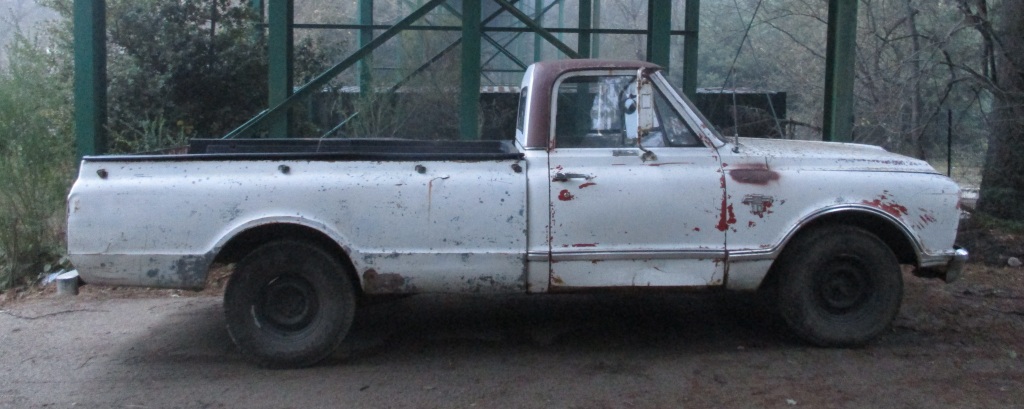
Frio de Ausencia

Apologies for may inability to maintain this blog with new content. Again, it is necessary to reblog an old article.

tonytomeo's avatarFelton League

‘Cold of Absence’. That is the direct translation. Is sounds prettier in Spanish, perhaps alluringly exotic. In reality, it is a sad song of unrequited love, composed by Gali Galeano of Columbia in 1981. I knew none of that until I looked it up online a moment ago. I knew ‘Frio de Ausencia’ only as the name of a tired old Chevrolet on a farm I worked on after I graduated high school.

No one knows why it was named ‘Frio de Ausencia’. I asked. The name was painted in black letters across the front of the gray hood. It makes no more sense to me all these years later than it did then. I do miss it though. It was such a simple and somehow stylish old pickup, at a time when contemporary vehicles innately lacked such qualities. It did anything we needed it to do.

I went off…

View original post 219 more words

Get A Job

If there were not so many more pleasant topics to discuss, there could be an another category on this blog about stupid things that people say about homelessness. One of the most inane and also most common questions about homeless people who are perceived to also be unemployed is, “Why don’t they just get a job?”. This question is very often accompanied by a mention of a local employer who happens to be hiring new employees.

Have any of those who say such trivializing things ever tried what they suggest for others to do? Most of us at one time or another have gotten a job. There is nothing unusual about that. What makes the primary question unusual is that it is in regard to homeless and seemingly unemployed people. Has anyone who asks this question tried to get a job while homeless and unemployed? Would those who ask this question hire someone who is homeless and unemployed?

Fortunately, there are a few employers without our Community who can hire homeless people, even though it is difficult for homeless people to wash, groom and regularly wear clean clothes. Presentation is not so important for some sorts of jobs. Unfortunately, other Communities are not so accommodating. Employers are unlikely to hire those who are unable to make a good first impression, or maintain such an impression. For many jobs, presentation is very important.

Furthermore, employment is not necessarily an immediate remedy to homelessness. Many gainfully employed people can not afford rent or a mortgage here. Even if they can, it takes a long time to save for deposits or down payments. Even after saving enough for a deposit on a rental, homeless people are likely be ineligible to rent because of imperfect credit as a result of losing their previous homes.

Fuentes Residence – Pacoima

This is just too delightful to not share. The video in the original article is even better.

By CHELSEA EDWARDS Published June 18 (2021)

A homeless encampment in Pacoima, California has turned into an art piece after a homeless man turned a hillside along a freeway into a home that comes complete with art and gardens.

The property was build and landscaped along the 118 Freeway by 65-year-old Jose Fuentes. He’s originally from Colima, Mexico.

Nathaniel Padilla is the owner of Taco El Canelo, a restaurant that is next to the encampment.

Padilla says, “He said he was a gardener. So he did landscaping, so he got really good with his hands.”

He says it is becoming something legendary.

Padilla says, “People love it. I have people climbing up the mountain to go give them gifts like he’s like he’s baby Jesus almost. I have many people come out and ask me questions about what’s going on. ‘What is this? Is this like a memorial?’ No, it’s not. It’s just a creative man at work.”

Padilla says Fuentes helps keep the shopping center clean and they have a great relationship.

“Honestly, he never does anything to offend anybody. So we don’t have any reason to call any police or anyone to remove him from here. He’s a really, genuinely nice guy, and we’re happy to have him here,” Padilla says.

City Councilwoman Monica Rodriguez addressed the encampment in a statement, accusing the state highway department of being negligent in maintaining the area and says that she, “continues to seek Caltrans cooperation and support to maintain their right of ways and work with appropriate agencies to coordinate services for the unhoused who are living on state property.”

Caltrans says it is working with various partners to moved the unhoused into safer situations and that due to COVID-19: “Caltrans is proceeding with the encampment cleanups if there was an immediate safety concern or threat to critical infrastructure.”

Fuentes says that no one has ever asked him to leave The hillside or has offered him housing but whatever happens, he’ll keep his creative flair.

He says, “They take it away. We move on. We build another place.”

Picnic In The Park With Some Homeless Folks – July 30, 2015

This doubly recycled article was already four years old when it posted here two years ago, so is now six years old.
Does it really get old?

tonytomeo's avatarFelton League

This article from the Press Banner is the best ever about this particular topic, which was an issue that concerned Felton League back in the summer of 2015. The main text is pasted below, but without the excellent picture or the interesting comments. The chronology of the comments can be difficult to follow, but each comment is outfitted with the date and time at which it was posted. Of course, some of the comments were deleted.

July 30, 2015 – Press Banner – Suellene Petersen

It would have been nice if a table had been available for the food, but Jonney Hughes explained that the maintenance people from the Santa Cruz County Department of Parks had removed the one that used to be in that spot.

“They
said they were going to fix the table and bring it back, but we could
not see that anything was wrong with it,”…

View original post 403 more words

Chateau du Mal Voisin

Derived from a misspelling and bad grammar, it is a fictitious place of the Peanuts comics. According to Charlie Brown, ‘Chateau du Mal Voisin’ translates from French into ‘Chateau of the Bad Neighbor’. Regardless of questionable syntax, it, in one form or another, is something that most of us can identify with.

The Chateau du Mal Voisin of the illustration here is fortunately not local. It is at the southeastern corner of the interchange of South Cochran Avenue and Venice Boulevard, just west of the Mid City district of Los Angeles. The picture was taken last December. The Chateau has been expanded extensively since then. Not only is it now larger than some of the two bedroom apartments on West Cologne Street in the background, but it has a spacious yard, a parking space for the occupant’s sedan, an ornate wrought iron security door, and, of all things, a mailbox. No building permits were issued. The resident pays neither a mortgage nor rent to live in this expensive neighborhood.

Those who do pay either a mortgage or rent to live here pay too much to contend with this in their neighborhood. Locally generated tax revenue is more than adequate to prevent this from happening, even if such prevention were to involve assuming the expense of providing more socially acceptable accommodations for the houseless. To be brutally blunt, this is unacceptable.

This certainly should not imply that the Community is not concerned for their houseless members. Like our local Community, the Mid City Los Angeles Community is remarkably generous and gracious in regard to helping their houseless neighbors improve their respective situations. In fact, that is what makes this Chateau du Mal Voisin so intolerable. It expresses a complete lack of appreciation for the graciousness of the Community.

Technically, people should not inhabit public spaces. The houseless do so only because they lack other options. Most attempt to be discrete and respectful of the Community, just as most of the Community is so respectfully accommodating and tolerant.

A Chateau du Mal Voisin such as this certainly confounds tolerance.

New In Town

The significantly declining rate of houselessness here during the past several years has been gratifying to say the least. Somehow, while houselessness has been increasing so substantially in so many other Communities, most who previously lacked a stable home here have procured domestic situations. It is so gratifyingly contrary to the external trend. 

The situation is certainly not perfect though. A few remain houseless because of inability to function within domestic or professional situations, or to exploit very limited resources that should be available to those in such condition. Sadly, some are the most vulnerable of society. Others have potential to inadvertently cause problems for other within society.

Furthermore, although uncommon, a few transient houseless people continue to migrate through our Community. Some have reason to be here. Others are here only incidentally. Most seem to be respectful of society; but it is impossible to know for certain. Even those with good intentions are unfamiliar with the cultural expectations of the local Community. 

While a few more of the local Community were houseless, this minor houseless transient Community was afforded significantly more opportunity for ‘local’ Community interaction. Ironically, this distinctly local interaction is limited by the declining rate of houselessness. Fewer of the few who remain unhoused locally are qualified to represent our Community. 

Some of the transient houseless people relocate to another Community before becoming acquainted with our Community and the associated resources that are available to them here. Those who stay longer eventually become somewhat familiar with our Community, but perhaps less efficiently than they otherwise would, with more Community interaction. 

Community outreach by those who have not been houseless is effective but impractical. Obviously, they have homes, domestic lifestyles, and, most likely, employment to devote their time to. Also, they likely lack adequate familiarity with houseless culture.

Interesting Question

It is perplexing that the local houselessness situation improved so significantly a few years ago, and then stabilized, both prior to and concurrently with such significant increases in the rates of houselessness in so many other Communities. Of course, the rate of houselessness increased drastically as a result of the CZU Fire last August, but then stabilized remarkably efficiently as many of the victims, with the assistance of home owners’ insurance, procured at least temporary domestic situations. Many of those who remain houseless as a result of the CZU Fire are living elsewhere temporarily, so are not as visually apparent as the more familiar local houseless.

This unusual improvement of the local rates of houselessness was questioned at my other unrelated blog, in conjunction with commentary regarding the contrary nature of such information, relative to the experiences of other Communities.

This was my reply:

“That is an interesting question that no one seems to have an answer for. The trend did not coincide with trends elsewhere. But of course, the unhoused Community here involves only a few people, so the ‘trends’ that we observe are much more variable than they are in more significant Communities. (For example,) if two people (of the approximately twenty of the unhoused who reside here) happen to procure a domestic situation, regardless (of) actual trends everywhere else, that is 10% of the entire unhoused Community locally. Several years ago, several of the unhoused passed away within only a few years. (. . .) More recently, some relocated for employment, or for available domestic situations. The housed Community here is very generous with helping the unhoused improve their situations. Not only has the situation here improved, but the fake news about it has not been proliferated as rampantly as it had been. A few years ago, the unhoused were blamed by a few haters for ‘everything’ bad that happened here. Society simply does not subscribe to that anymore. We recognize the few haters for who they are. (. . .)”

Advantages Of Homelessness

This recycled article from last summer is still one of my favorites, even if only those with experience would believe it.

tonytomeo's avatarFelton League

Many of the disadvantages of homelessness are obvious. There are many more that are not so obvious. Those who have experienced homelessness would not likely recommend it to others who have not experienced it.

Domestic lifestyles are generally more pleasant, and generally afford more options for correction of that which might be unpleasant about them.

Yet, those with securely domestic lifestyles commonly complain about what their lifestyles entail. Furthermore, they sometimes attempt to correct perceived deficiencies of their respective lifestyles by unproductive means.

Some of the homeless are just as likely to comment on some of the advantages of homelessness, and often express gratitude for assistance from those with securely domestic lifestyles.

The main advantage of homelessness might be the lack of major expenses, such as mortgages and rents. The associated costs of property taxes and home owners’ insurance are also negated. Most of the homeless lack cars, so need…

View original post 150 more words

Firewood

Firewood is just as relevant now as it was when this recycled article originally posted, but, for now, may not be so readily available. Ironic, is it not. So many who might otherwise be cutting and splitting wood are busy with vegetation management and removal of debris that was generated by the CZU Fire last summer. Much of the vegetation and debris gets processed into firewood immediately, but much gets stockpiled for later processing. Furthermore, a few of the most proficient wood cutters have temporarily relocated for other employment. There should be a surplus of firewood after everyone get what they need. It just might be processed and procured a bit differently than it typically is.

tonytomeo's avatarFelton League

Some of us have done good business with firewood. Only a few have cut, split and sold it as a career. More have done so temporarily between occupations. There are always trees that need to be removed. There is also a seasonal need for firewood. The work is not easy, but it can be somewhat lucrative, which is helpful for those lacking better income.

The quantity of firewood consumed locally must be significantly less than what is consumed in harsher climates. Winters are neither very cold, nor very long here. That is why trees need not be cut down just for firewood. Plenty of firewood is retrieved from trees that fall or need to be removed. Nonetheless, there is plenty of work processing firewood for those who want it.

Firewood season never ends here. No one is in a rush to get their wood stacked before spring so that it…

View original post 150 more words