Again, because of other obligations, I must recycle this old article rather than write something new for this week. It might be a few weeks before I can resume writing.
We never know who will read what we post online. It is not like old fashioned newspapers that could only be read as far away as the printed pages got dispersed. Everyone with access to the internet has access to this.
Nowadays, there is nothing unusual about that. Just
about everything is online. What is unusual is that so many outside
of our distinguished Community are interested in reading about us.
This ‘blog’ (Gads! I hate that word!) is not even a
month old, and contains only a few brief posts that are not
particularly compelling. Yet, posts have been read by quite a few
visitors, including some who are nowhere near here. There is
certainly nothing wrong with that. In fact, it is rather gratifying.
It is just unexpected.
Many of the issues that concern our minor local
Community are common concerns that affect many other Communities all
over the World. Nonetheless, different societies contend with such
issues in their own unique ways. Are our techniques somehow relevant
to other cultures and other societies? How similar are they? How are
they different?
It will be interesting to see where outside of America
our posts get read. So far, they have been read in the United
Kingdom, Australia, New Zealand, India, France, Switzerland and
China. If it were possible, it would also be interesting to see where
within American the vast majority of those reading our posts are
located.
Furthermore, all this interest in our distinguished
Community stimulates interest in others who are concerned with some
of the same issues that concern us, but from within the context of
potentially very differnt cultures. Is homelessness really as
tolerable in India as so many of us believe it to be? How do the
homeless of Switzerland survive the dangerously harsh winters? That
is what the World Wide Web is for.
The recycled article below is more than a year old, from a time when groups could gather. It may not seem to be relevant while there are no social events, but it will eventually become relevant again. It will be interesting to see how minimal the turnout for some of our familiar social gatherings will be. It was already very minimal prior to the current situation. So many who had formerly lacked a domestic situation or employment have become too busy with new domestic and professional obligations to attend.
(I am sorry that I am presently unable to write new articles as I had been. I do not know when I will resume. As I mentioned, the article below is recycled from more than a year ago.)
Big crowds are proportionate to the popularity of an event. They are sort of expected at exhibits of famous art, important baseball games, and Aaron Tippin concerts. There was quite a crowd at the Felton Remembers Parade and Covered Bridge Festival.
Smaller events draw much smaller but relatively significant
groups. It is always nice to see children celebrating birthday
parties in Felton Covered Bridge Park. Community Bridges (Mountain
Community Resources or MCR) still does play dates for children there
as well.
Our group is very unique. We get good turnout for our special
events too, if we plan ahead for them, and extend invitations.
Otherwise, for regularly scheduled events, such as lunch at Felton
Presbyterian Church on Tuesday, and lunch at Saint John’s on
Thursday, minimal attendance is an indication that more of us are
doing well, and are unable to attend because we are at work, or busy
with other responsibilities.
It is not as if we are an exclusive group that others want to be
members of. Although just about anyone can join, most do so only out
of necessity, but prefer to move onto better situations.
There were more of us in 2013 than there are now. Those who have
joined our group since then have been less numerous than those who
have found homes and employment. There are now fewer of us than there
have been in a very long time. In that sense, minimal membership is a
good thing.
It is unfortunate that this is not a common trend in most other
places. Some of the same social difficulties that are less prevalent
here than they had been are instead becoming more common elsewhere,
particularly in more substantial towns and big cities, such as San
Jose, Watsonville and Monterey. Are we doing something differently
here?
As I mentioned last week, other obligations presently prevent me from writing new posts, perhaps for several weeks. For now, this old article from May of 2019 will be recycled.
Fake environmentalism is a HUGE topic, so for now, will be limited
to fake environmentalism as justification for the eviction of
homeless encampments.
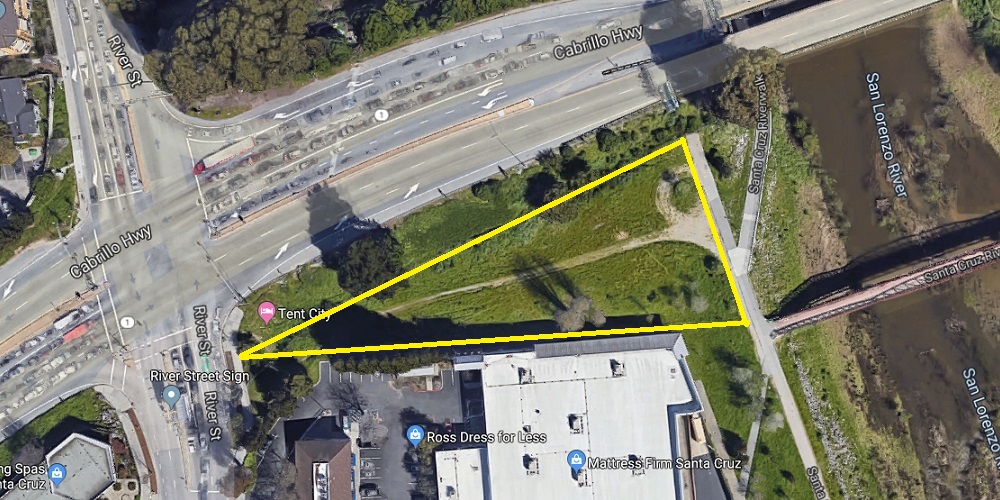
The yellow triangle in the picture above was the site of the
Hero’s Camp, which was more commonly known as Ross Camp, and located
behind Ross Dress For Less in Gateway Plaza in Santa Cruz. It is gone
now. This satellite image was taken by Google Maps prior to the
development of the Camp. I did not get pictures of the camp while
inhabited, but you have likely seen enough other camps in the news to
imagine what it looked like.
It really was as big as it looks, and really did exhibit all the
problems that you hear about in the news, although not to such an
exaggerated degree. Not everyone there used syringes to inject
illicit narcotics. Not everyone there was an alcoholic. Not everyone
was violent, from somewhere else, or a criminal. This is not about
such issues anyway. It is about how the two hundred or so unhoused
people who lived here affected the environment.
Was there trash? Of course there was. Was it more than what two
hundred people who live in homes generate? No. Houseless people do
not generate as much trash as the housed, simply because they lack
resources to purchase the commodities from which so much trash is
generated. The houseless certainly do not waste as much as the
housed. Their trash just happens to be more visible for outsiders who
do not know any better to see.
Furthermore, what is so typically described and perceived as trash
is actually the belongings of those who live in such camps. Without
closets, cabinets or furniture, our belongings would look about the
same, except much more voluminous. When we take just some of the
belongings that we don’t want or need and put them out in front of
our homes, it is a garage sale, and likely amounts to much more than
individual homeless people own.
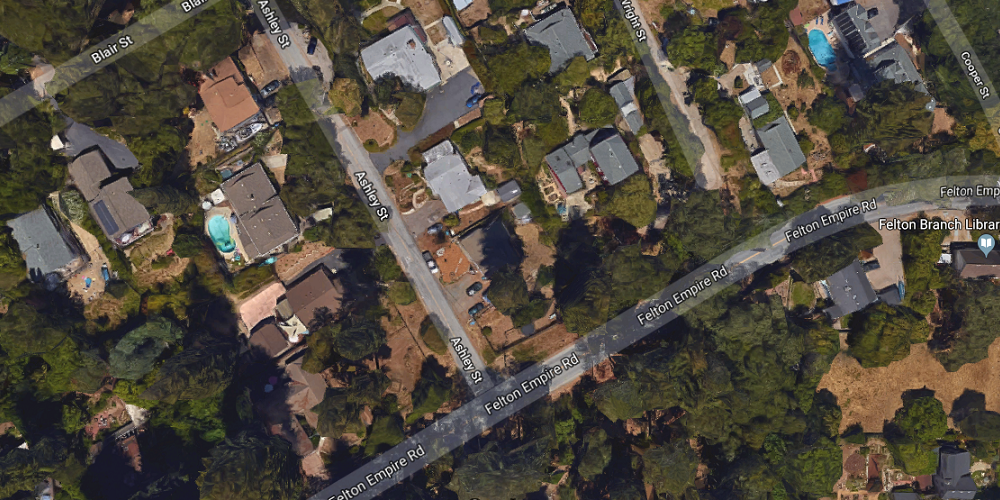
The satellite image from Google Maps below shows the neighborhood
where my grandparents lived in Felton, less than seven miles north of
where the picture above was taken. Their old home is right in the
middle of the picture. There were not so many other homes there when
they arrived, just as World War II was ending. They lived a
relatively modest lifestyle, on a small suburban parcel. They were
not concerned about the environment.
Why should they have been? Even now, the people who live in homes
here can generate as much trash as they want to, and no one will
complain about it. They can fill their homes with their belongings,
and put them neatly away in closets, cabinets and drawers. There are
alcoholics in this neighborhood, as well as a few who are addicted to
illicit narcotics. Some are criminals. Some are violent. Few are
native. Again, this is off the main topic.
None of that is visible in this satellite image anyway. What it
shows instead is how the lifestyles of those who live in homes are
more detrimental to the environment than the lifestyles of those who
lack homes. This picture is the same scale as the picture above, so
you can see that only a few homes would fit into an area comparable
to that in which about two hundred unhoused people lived. Only a few
people live in each of these few homes.
What that means is that two hundred people like those who lived at
the Hero’s Camp live dispersed over a much larger area, on land from
which trees and vegetation needed to be removed. They all live in
homes that are made of wood derived from trees that grew in forests.
These homes are furnished with synthetic plaster, carpet, paint,
glass, vinyl, metals and all sorts of materials that needed to be
quarried, processed or manufactured.
It doesn’t end there. These homes consume energy for heating,
lighting and whatever else that gas and electricity are used for.
Cars driven by those who live in homes are also constructed from raw
materials, and then need fuel to function. Water is consumed as if it
were not a very limited resource. Much of it gets mixed with soaps
and detergents before going back into the environment. Chlorine
volatilizes from chlorinated swimming pools.
Then there are the landscapes and gardens, the parts of domestic lifestyles that we actually believe to be beneficial to the environment. They contain exotic (non-native) plants that compete with native species, and interfere with natural ecological processes. Irrigation of the landscapes stimulates growth of redwoods, and accelerates decay of oaks. Soil amendments, fertilizers and some of the pesticides change the chemistry of the soil and ground water.
Just compare these two pictures. As bad as the mess at Hero’s Camp
was, the two hundred people who lived there were less detrimental to
the environment and the local ecosystem than those who live in just a
few of the homes visible in the picture below. Those who claim to be
concerned about the environment should be more concerned about the
ecologically detrimental lifestyles of those who live in homes than
those who lack homes.
(Incidentally, the title was changed slightly from the original post [in another blog] to conform to the meme of ‘Hypocrisy’.)
Other obligations prevent me from writing something new for this week. I may not be able to write anything new for quite a while. Instead, this old article that was re-posted from my other blog in May of 2018 will be posted again. (I am getting significant mileage out of this article.) The other blog happens to be a gardening blog, which is why this says more about the trees than about the campsite below them. This is the article below:
There happen to be quite a few campgrounds in the region, with one
about a quarter of a mile upstream from where this picture was taken,
and another less than three miles past that. Both are primarily used
by school age children. The vast redwood forests with creeks flowing
through are ideal for such campgrounds.
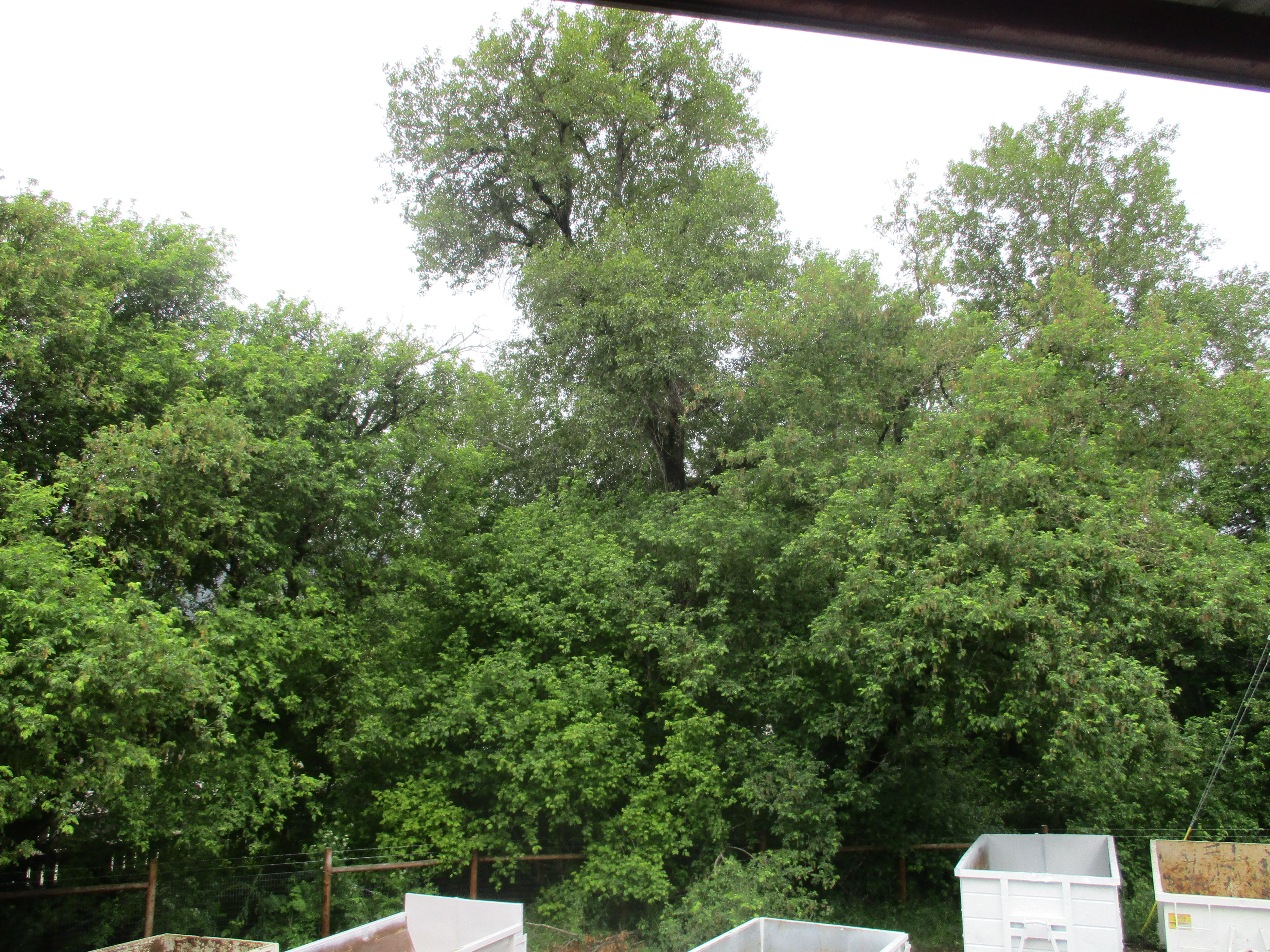
This is a campground too. I know it does not look like it. It is
located between a creek and an industrial building, the eave of which
is visible in the top right corner of the picture. The herd of
dumpsters that is barely visible at the bottom of the picture might
include a dozen dumpsters at at time. (I tried to get both the eave
and the dumpsters in one picture.) There really are two rows of
barbed wire on top of that fence behind the dumpsters.
Nonetheless, it is a campground. You see, individuals who lack
adequate shelter occasionally camp on a flat spot next to the creek,
right below the big cottonwood tree in the middle of the picture. It
is not a big space, so can only accommodate one or maybe two people
at a time. No one has been there for quite a while. Yet, on rainy
days like today, it is saddening to imagine someone camping there, so
close to inaccessible buildings.
Because the area is outside of landscaped areas, I do nothing to
make it any more comfortable as a campground. I only cut away the
limbs that fall onto the fence.
The trees are a mix of mostly box elders, with a few cottonwoods
and willows, and even fewer alders, with one deteriorating old
bigleaf maple. They concern me. Box elders, cottonwoods and willows
are innately unstable. All but bigleaf maple are innately
structurally deficient. Although bigleaf maple should innately be
both stable and structurally sound, the particular specimen in this
situation is in the process of rotting and collapsing.
I really do not mind if limbs or entire trees fall into the
forested riparian zone. If they fall outward, they do not damage the
dumpsters. Only the fence needs to be repaired. What worries me are
the potential residents of the campground. Part of my work is to
inspect trees for health, stability and structural integrity, and if
necessary, prescribe arboricultural procedures to make them safe. I
just can not do that here.
UPDATE: Just after this article posted at midnight, a very big box
elder off to the right of those in the picture fell with a loud but
quick crash. It was probably the biggest and most deteriorated of the
box elders in this area, and pulled completely out of the ground to
reveal that the roots were so decayed, that none stayed attached to
the stump. Seriously, you should see the pictures when they get
posted next Sunday.
Information regarding the main causes of homelessness is always confusing. There are too many dynamic variables to limit the precision of data, even within a specific region and time range. Nonetheless, unemployment is consistently one of the most common causes of initial homelessness. Most studies rank it at the main cause. Others rank it as the second most common cause.
While so many were unable to work during the ‘Stay At Home’ order, the Eviction Moratorium was enacted to temporarily prevent evictions of the unemployed who were unable to pay their rent or mortgages. Otherwise, more of us could have become homeless by now. Unfortunately, it is not a perfect solution, and temporarily deprives landlords of their needed rental revenue.
Now that so many are able to return to work and earn revenue again, the past due accounts of rents and mortgages will continue to be a major expense for those who do not earn much more than a modest cost of living. Some could still become homeless. Some might need to relocate. Because some businesses will not recover, some of us will likely need to seek other employment.
Unpleasant predictions of increasing homelessness during the next few months might not be totally inaccurate, but mostly seem to be exaggerated. Most landlords and mortgage holders are likely to be more willing to negotiate reimbursements of delinquencies in order to avoid foreclosures and vacancies. It might be difficult to replace tenants while so many can not afford rents.
It seems that most within our Community who are still unable to work have already procured alternative employment. For some, such alternative employment is only temporary until they can resume their normal employment. Although no one should have become homeless because of unemployment during the eviction moratorium, a few are planning to relocate.
Where have all the houseless people gone? There are noticeably fewer of them here now than there were only a few years ago. Some have gone nowhere, but are merely no longer houseless and prominently visible about town. Some have relocated in order to procure a domestic situation. For some, relocation is only temporary for employment. Many are doing remarkably well.
It has been several years since a lady who had lived in a camper here purchased a relatively luxurious home in Arizona, and then invited another friend to live there with her. It was a major change of lifestyle for both of them, but they adapted well, and now enjoy living there. The second friend to go would prefer to eventually return to Felton though. There’s no place like home.
A formerly houseless couple who had been living both here and Copperopolis procured a home in Copperopolis three or four years ago, and continues to visit friends here every few months. They have been to Colorado at least twice to visit another formerly local houseless gentleman who relocated there several years ago, in about 2012. He now lives with his daughter’s family.
In about 2013, another formerly local houseless couple purchased a comfortable home in Fremont. The camper they had previously inhabited stayed parked next to their garage for quite a while before they finally sent it to a recyclery. It was not easy. That old camper had been their home through some very difficult times, as well as some excellent times. ‘Home Sweet Home’.
Even without their names, their stories are gratifying. There are more like these, and there will continue to be more. If only there were more stories of houseless people finding homes than there are of people losing homes, until everyone lives in a home.
Homelessness may not be more prevalent in all big cities than it is here, but it can be more visible where it is more concentrated. Nearly one percent of the populace of California is currently homeless. If that many are homeless in Felton, they are not obvious about it. Some reside with friends, or camp out discretely in their vehicles. Others make camp where obscured by forest.
Residing temporarily with friends may be no more difficult in big cities than it is here, but the other options are. There are fewer places to park discretely, and fewer forests to obscure even a minimal campsite. Furthermore, there are many more homeless people competing for the same very limited supply of discrete and obscured real estate in which to park or establish camp.
The ratio of homeless people relative to the rest of the populace may be no greater in big cities, but the total number of homeless people is overwhelming. One percent of the million people in San Jose is ten thousand, although not so many there are homeless. The population of Los Angeles is four times that of San Jose! Sadly, more than forty thousand people are homeless there.
Vast residential areas within these big cities lack resources that homeless people need to be close to, so in that regard, are inhospitable to homelessness. Consequently, the homeless populace tends to congregate where resources and campsites that are perceived to be discrete are more available. However, it is impossible for so many congregated homeless people to stay discrete.
We are very fortunate to reside within a Community that is so generously accommodating, and where those who want to assist homeless people are more able to do so. Homelessness here is not such a daunting problem like it is in bigger cities.
There are no simple solutions to all the financial difficulties associated with the inability of so many to earn their normal income during this current situation with Coronavirus. So many of us simply can not afford what we could previously afford. Mortgages and rents are the most significant expenses for many who are now unemployed, so many of us will be unable to pay them.
The current eviction moratorium protects those who might otherwise be evicted from their homes or commercial properties for their inability to pay their mortgages or rents. However, it is no remedy for the disruption of revenue that those who own the mortgages or rental properties rely on. Many of them also need to pay mortgages and rents. Everyone has innate expenses.
It will take a while for those who own rental properties to recover from any lapse of revenue, but it will likely be easier than renting to new tenants while so few can afford to rent. Similarly, it will be easier for lending institutions to recover from delinquencies of mortgage revenue than to foreclose on so many properties simultaneously. It is no simple solution, but it likely helps.
The main advantages of eviction moratoriums are that fewer businesses will need to vacate commercial properties, and fewer people will become homeless. These are significant advantages! Homelessness is already a problem for those who are currently experiencing it. Society can certainly do without more functional and formerly gainfully employed people becoming homeless.
We are so fortunate to live within a society that is both very generous to those who lack homes, and proactive in facilitating the retention of homes for those who have them. Otherwise, more of us would likely be homeless soon. Recovery from this currently unpleasant situation will be a long and difficult process.
Civilization has always been been influenced by various forms of discrimination. Even in modern America, where we like to believe that most types of discrimination have been dispelled, we are regularly reminded that some of the worst remain. Some forms of discrimination get recycled and reassigned, as if they will be more tolerable if applied to more appropriate victims.
Society can be rather discriminating about who it discriminates against.
People of African descent have always been discriminated against in America. Racists who justify such discrimination might consider them collectively to be more innately prone to thievery, as well as violence, vandalism, addiction, exploitation of social services, and any other social transgression that imaginative racists can conceive. It is what justifies racism and discrimination.
Historically, people of Asian descent, particularly Chinese descent, were collectively considered by racists to be more innately prone to addiction (to opium), as well as thievery and squalorly lifestyles. For a disgraceful period of American history, people of Japanese descent were incarcerated merely because they were racially related to enemies of America during World War II.
Many racists still consider Indigenous People of North America to collectively be more innately prone to alcoholism, as well as the many other transgressions that people of African and Asian descent are similarly blamed for. It is a common and typical pattern of racism and discrimination. Behavior that should be attributed to environment is instead attributed to genetics, or race.
It is easy enough to find pictures or other documentation of people conforming to the stereotypes of their respective racial designation. ‘Nature versus Nurture’ need not be mentioned if the objective is to justify racism and discrimination; although disproportionate conformation typically is mentioned. Justification of racism and discrimination rarely involves the use of any logic.
Now that racial discrimination is very slowly becoming less socially acceptable among common American society, some of those who might otherwise be racist are directing more unfounded hostility to other groups, such as those who are wealthier or more impoverished, including the homeless. Because this sort of discrimination is not racist, society is slightly more tolerant of it.
However, modern American society is realizing that unfounded discrimination against some of the homeless is merely a different flavor of the same recycled racial discrimination that is now so stigmatized. The irrational hostility and lack of logic eventually make it obvious. We have seen it all before, continue to see it, and sometimes see it in initially unrecognizable incarnations.
While most of us are willing to comply with social distancing standards, a few complain vehemently about it. Of these, some blame President Trump for the current situation. Some blame the Liberals. Some insist that it is a conspiracy to destroy the economy. Yet, they all lack the education and experience of those who developed and implemented the social distancing standards.
In other words, they do not know what they are talking about, but they all think that they are experts.
Understandably, many of us want to return to work! Many are frustrated by confinement and want to get out and about like we did prior to this situation. The rational among us do what we must until that is again possible. The irrational sort can potentially prolong this situation by noncompliance to social distancing standards. Society suffers the consequences of their ignorance.
The ignorance of those who lack practical experience with homelessness, but believe that they are qualified to make recommendations about it, is just as irrational. Although such ignorance is rare, we all have encountered it at one time or another. Those who express the most extreme of ignorance and irrationality are too ignorant and irrational to realize it. Consider the source.
For example, some have made the recommendation that homeless people should just relocate to where they would not be homeless, but do not reveal where such a place is. Some homeless people do relocate for a home that happens to be available. It would however be pointless to relocate to be homeless in an unfamiliar situation. Nor should anyone relocate to be unemployed.
How many of those who make such trivializing recommendation had been homeless, and tried to find a home without a deposit, exemplary credit, sufficient income or stable renting history? How many are even aware that many of the homeless lack a combination of these assets? What qualifies anyone lacking such relevant experience or insight to make such recommendations?

 Felton League